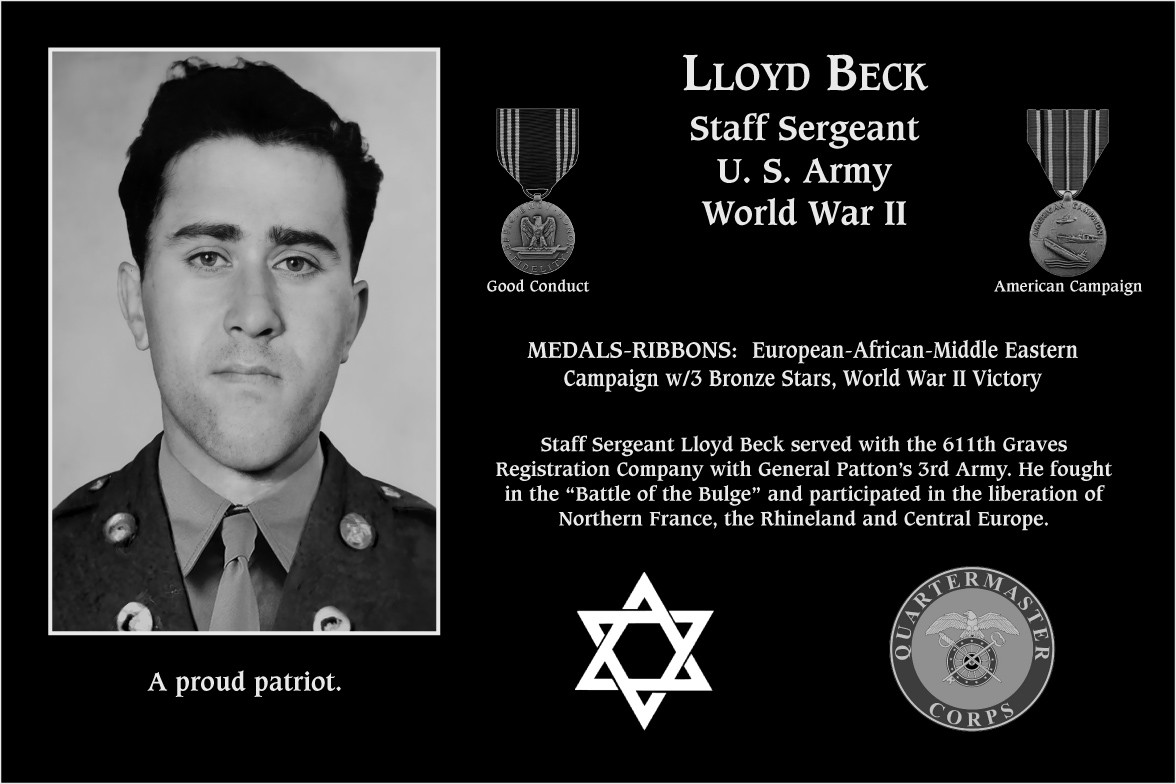
Lloyd Beck
| Era | WWII |
|---|---|
| Branch | U.S. Army |
| Rank | Staff Sergeant |
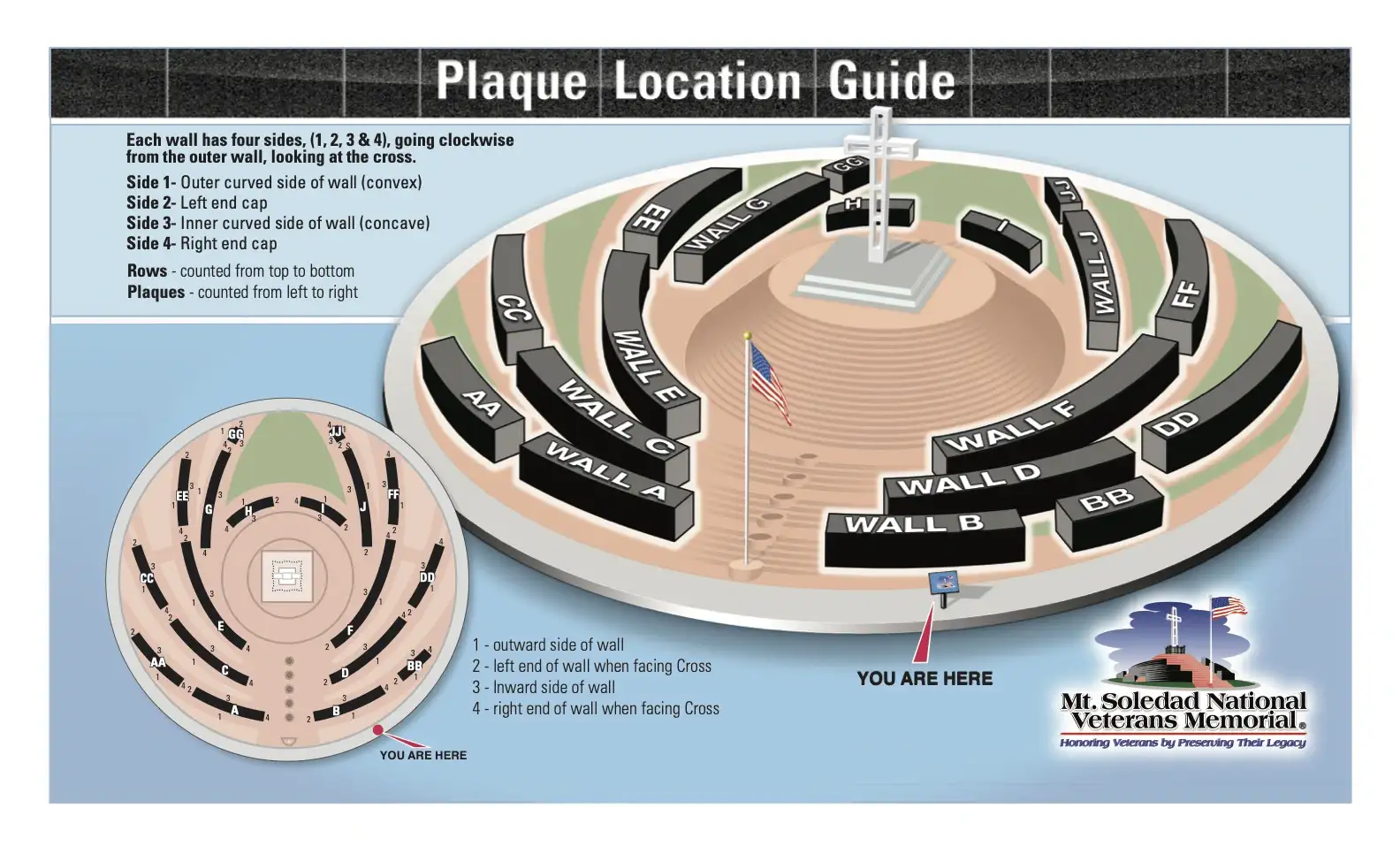
| Wall | AA |
| Wall Side | 3 |
| Row | 3 |
| Plaque Number | 5 |
Lloyd Beck emigrated to the United States in 1939 at the age of 20 from a village in rural Czechoslovakia. He was the youngest of nineteen children. He completed high school, a rarity in the region, and learned the meat butchering trade from his late father. Having been drafted into the Czech army, and aware of the advancing Nazi menace and the plight of Jews in Poland, he left behind his mother and eight older sisters to come to
America. (The rest of his siblings had already emigrated to the U.S. and Palestine.) With very limited funds and little more than the clothes on his back, he made his way to Prague and obtained a six-month visitors’ visa to the U.S., arriving at Ellis Island like so many. He spoke five languages, though not English.
Lloyd’s destination was Detroit, MI where several of his older brothers and sisters were living. By day he worked as a journeyman butcher in Detroit’s meatpacking district; by night he attended school to learn English and study American history. Slowly he assimilated into American life and met his future wife, Hermine Feldman, at a family wedding in 1941. They married in 1942; later that year he enlisted in the United States Army. He soon found himself back in Europe, a private in General George Patton’s Third Army, eventually becoming the mess Staff Sergeant in Quartermaster
Company 611. He served in Northern France, the Rhineland, and Central
Europe, and fought in the Battle of the Bulge. He was a member of the U.S. forces that liberated the Ohrdruf concentration camp. Lloyd was honorably discharged December 1945, returning home a naturalized U.S. citizen.
In 1946, Lloyd and Hermine headed west to Los Angeles, CA to begin their new life. With the nest egg Lloyd had sent home over the course of his Army service, and with encouragement from Hermine’s family members already settled there, they established a small business with one refrigerated truck, selling premium beef to the fine restaurants in the city. Soon, they grew that venture into a small meat packing plant, Western Packers, located in Vernon, CA, which they gradually enlarged to a fullscale operation including a smokehouse that produced epicurean meat products for which the company became renowned. By the early 1960s, Western Packers enjoyed a national reputation, and they expanded to a chain of retail butcher shops across greater L.A., called Golden West Meats. The two companies employed hundreds of union workers. Lloyd was often referred to as “The White Tornado” for his prematurely whitegray hair and indefatigable personality. While he was a man of medium physical stature, he had large ambitions and a grand vision for himself and his family. He was always on the go, thinking ahead, and leading his businesses to his exacting standards.
Lloyd worked 18-hour days, 6 days a week, for many, many years to realize his American dream. Hermine and Lloyd had three children (two sons and a daughter) who were raised and educated with opportunities and advantages unimaginable in his tiny village in Czechoslovakia. The Beck family was well regarded in the Los Angeles Jewish community for their philanthropic and cultural activities. Lloyd retired at the age of 60, enjoyed playing golf and traveling only to warm weather locales after so many years spent working in the freezers of his plant. Sadly, he was diagnosed with Parkinson’s disease at age 65 and passed away at age 78. He was survived by Hermine, his three children, and four grandchildren.
After the war, they learned that Lloyd’s mother and eight sisters had perished in the concentration camps. In 1973, Hermine was able to locate one surviving niece of his living not far from Lloyd’s original home in rural Czechoslovakia, an area that is today part of Russia.
Among his many accomplishments, Lloyd prized his American citizenship earned through his military service and was deeply grateful for the opportunities that this country provided.
He was, above all, a proud patriot.
Plaque Wall Map