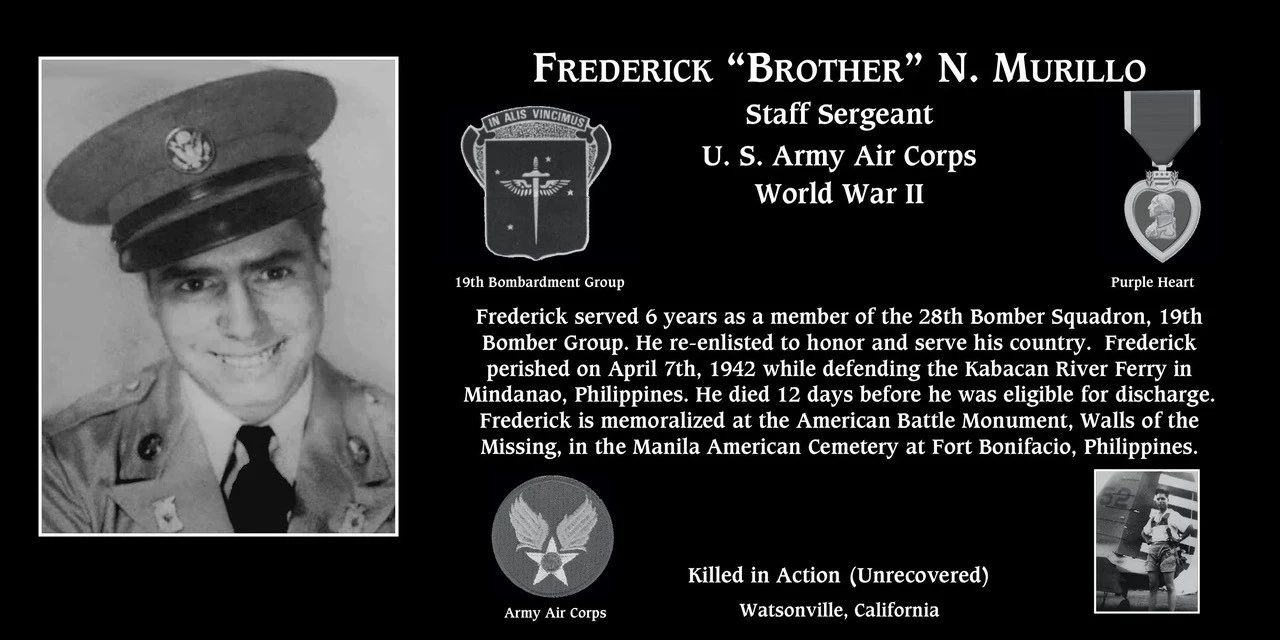
Federick "Brother" N. Murillo
| Era | WWII |
|---|---|
| Branch | U.S. Army Air Force |
| Rank | Staff Sergeant |
| Military Decorations | Purple Heart |
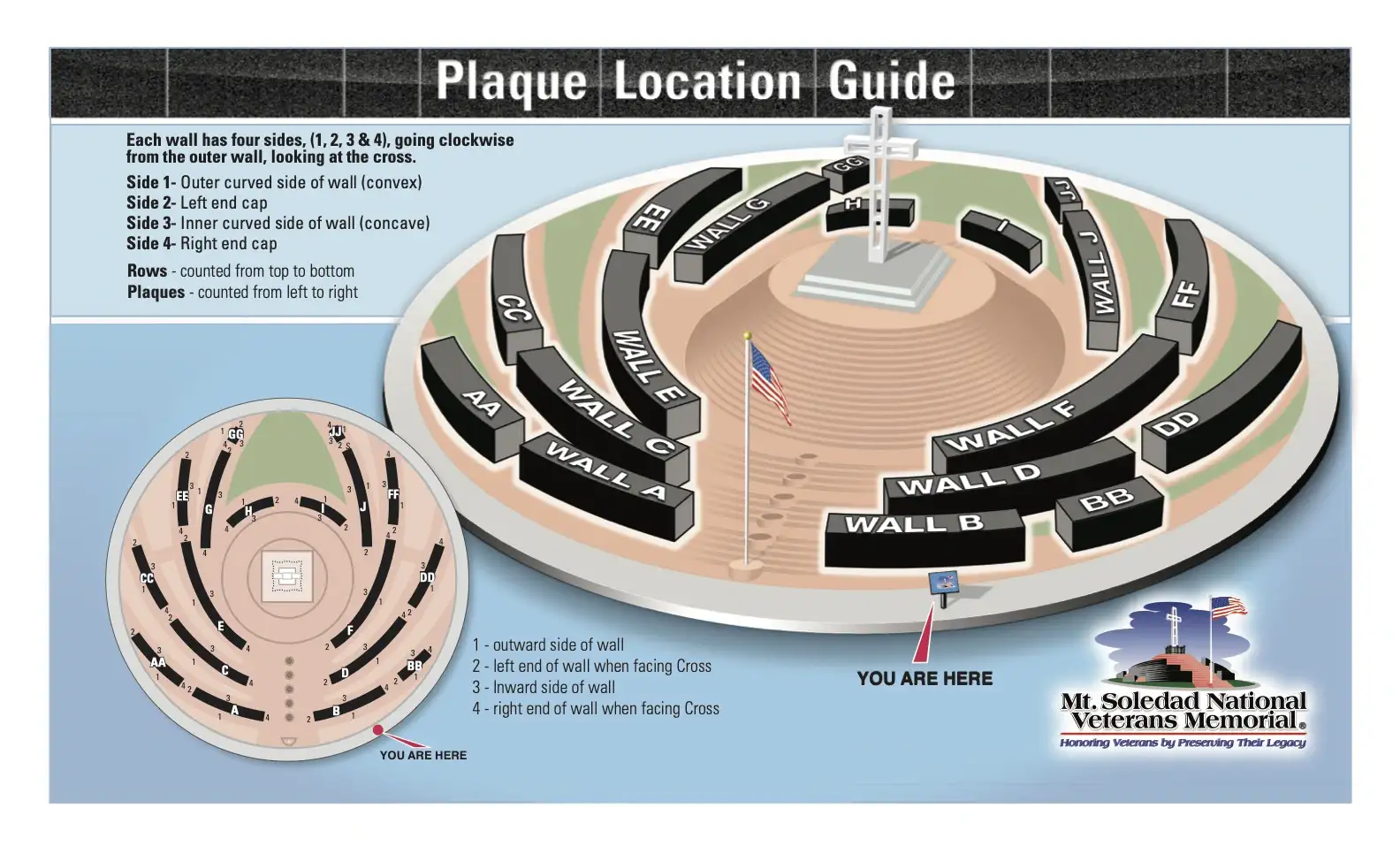
| Wall | C |
| Wall Side | 3 |
| Row | 4 |
| Plaque Number | 9 |
Frederick served 6 years as a member of the 28th Bomber Squadron, 19th Bomber Group. He re-enlisted to honor and serve his county. Fredercik perished on April 7th, 1942 while defending the Kabacan River Ferry in Mindanao, Philippines. He died 12 days befor he was eligible for discharge. Frederick is memorialized at the American Battle Monument, Walls of the Missing, in the Manila American Cemetary at Fort Bonifacio, Phillipines.
Staff Sergeant Frederick Norman Murillo was born in Watsonville, California on September 15th, 1916, to Betty Gene Wonderlich and Frederick Narcissio Murillo, my grandfather. Frederick, was raised in Monterey, California by his mother Betty and Stepfather Joseph Duckworth, Chief of the Monterey Police Department.
Frederick enlisted in the Air Force in 1936 at 19 years old and re-enlisted on April 19, 1939. He was trained at Hamiliton Field Air Force Base in Novato, California and spent time at Fort McDowell (now Angel Island) in San Francisco. In October of 1939 he was sent overseas to Clarke Field in Manila, Philippines on Luzon Island. We know he boarded a transport ship in San Francisco that took him through the Panama Canal to New York. Unfortunately, we are unaware what other transition points he had before he arrived in the Philippines.
Staff Sergeant Murillo served as a Bombardier for the Army Air Force. He was attached to the 28th Bomber Squadron, 19th Bomber Group. His office was the front glass nose cone of a Boeing B-17 Flying Fortress. His responsibilities included manning a machine gun, called a chin turret, for defensive purposes throughout the long flights, and ultimately, during the bomb run, sighting the target through the tachometer and releasing the bombs on enemy targets.
As a result of the rising tensions with the Japanese Empire in 1940, the defenses of the Philippines were judged to be abysmal, and a reinforcement effort was made to defend the islands against any Japanese aggression. The 28th Squadron was assigned to the incoming 19th Bombardment Group at Clark Field in the Philippines. The 28th, however, was filled with new pilots fresh out of flight training that were sent to reinforce the Philippines. By December 1st, 1941, the 19th Bombardment Group had all four of its squadrons at Clark Field.
On December 7th (Pearl Harbor Day), there were 35 B-17s in the Philippines, with 19 planes at Clark Field on Luzon and 16 B17’s at Del Monte Field 500 miles south. A fifth squadron with 6 more B17’s was inbound from Hamilton Field,
Plaque Wall Map