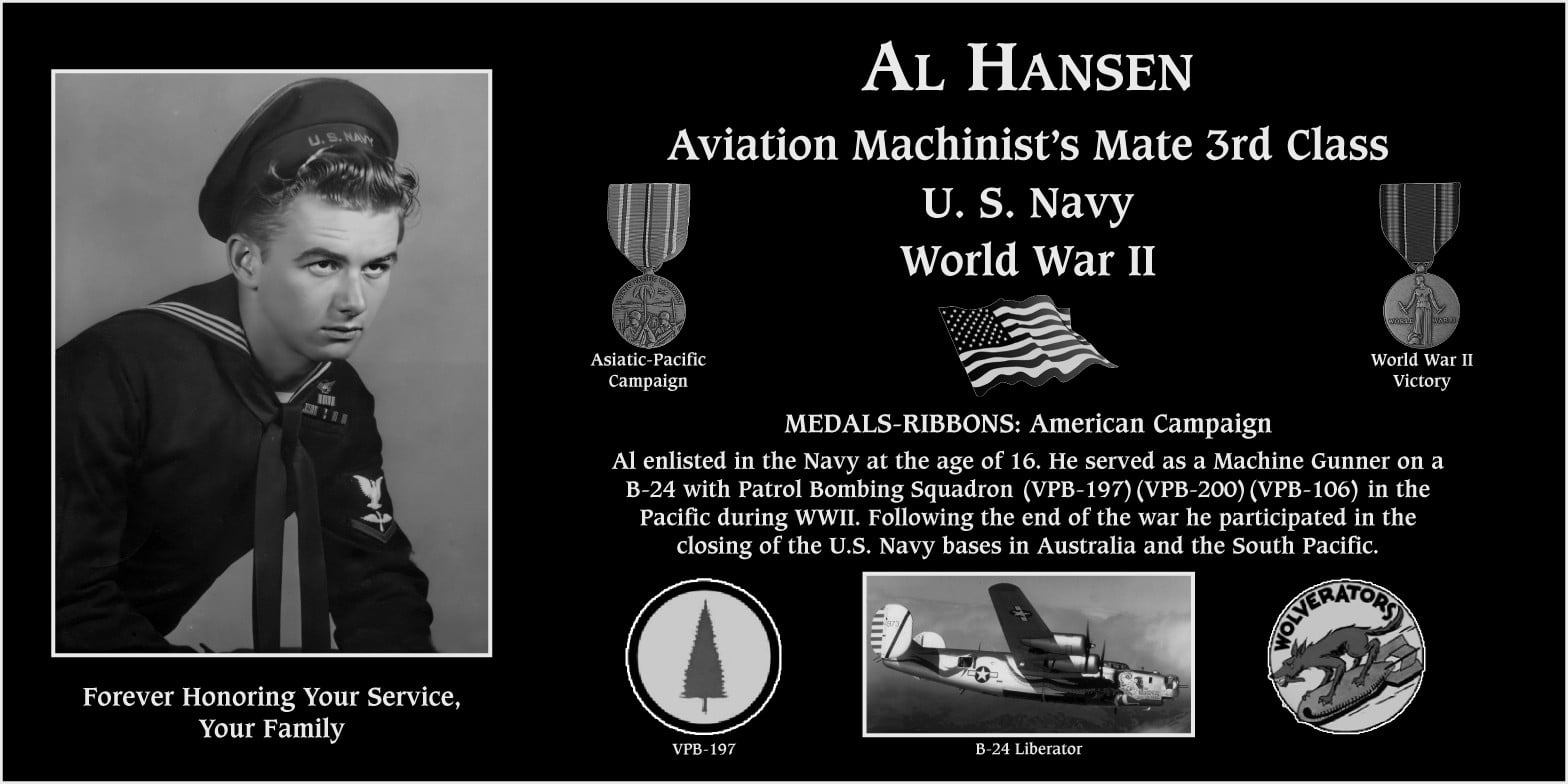
Al Edward Hansen
| Era | WWII |
|---|---|
| Branch | U.S. Navy |
| Rank | Seaman/Airman/Fireman |
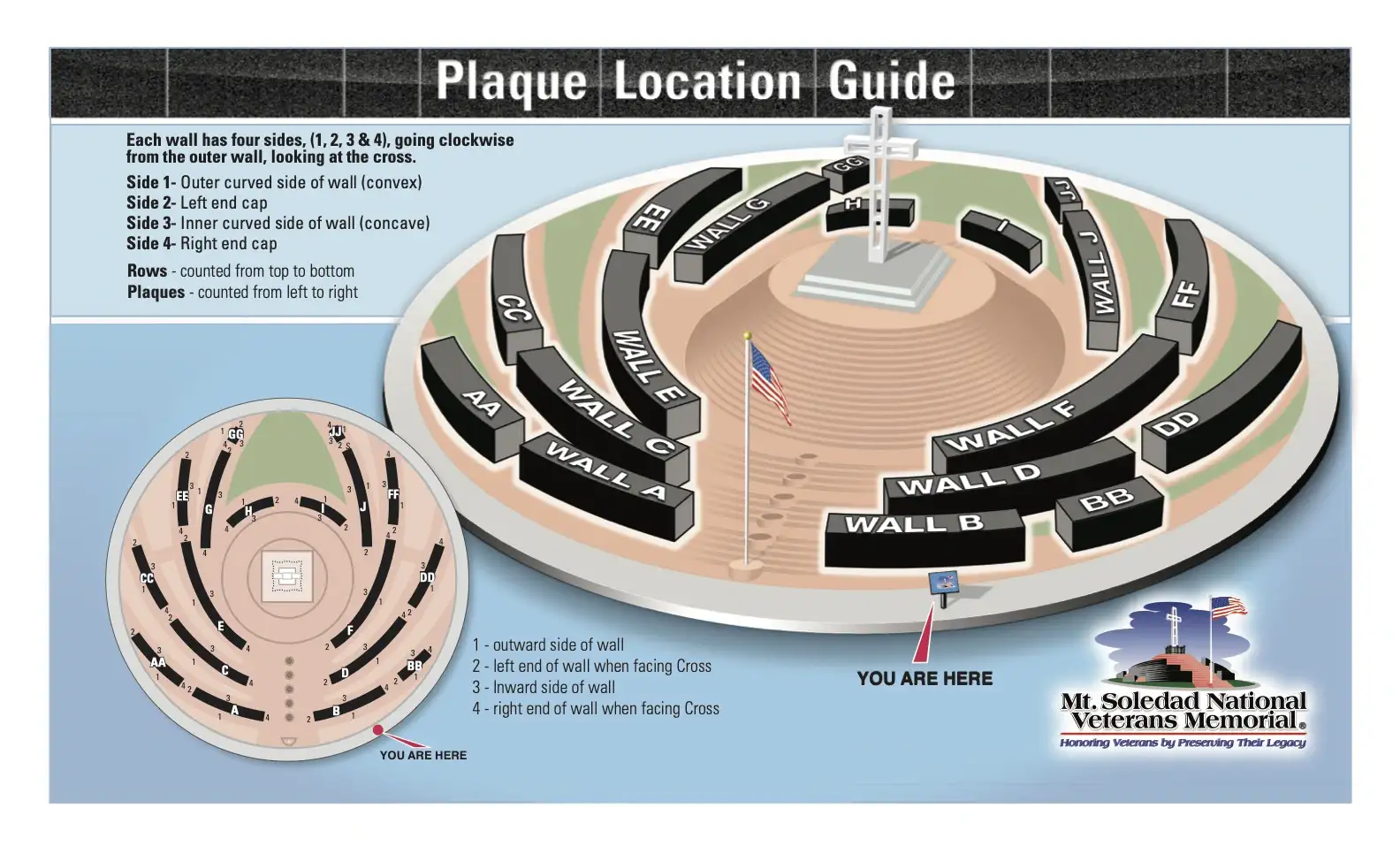
| Wall | AA |
| Wall Side | 3 |
| Row | 4 |
| Plaque Number | 1 |
A
Al Hansen was born un Hollywood, California and was 16 when his dad died. He had three younger siblings. His 4’11” tall Mom worked at a restaurant where the only money she made was in tips. It was during the depression, so a nickel or a dime was a standard tip – a quarter was a huge tip and rare. They lived in a two-bedroom cold water flat. Al quit school after his dad’s death and began to get into trouble. His small hometown had a population of about 600 people where everyone knew everything about everybody. As he started to get into deeper trouble, the mayor and the chief of police went to his mother and told her that if she would sign a paper stating that Al was 17, the Navy would take him. At first, she said no, but later somewhat hesitantly agreed.
Boot camp for Al was six weeks at Camp Peary, Virginia. He was then ordered to Memphis, Tennessee, for ordinance school to become an aircraft gunner. His monthly paycheck was $66.00. His commanding officer found out the history of why he enlisted at such a young age and “strongly suggested” (ordered!) him to send half his pay home to his mother. Al was fine with that suggestion.
His was first a Machinist. His next assignment was as a back seat gunner in an SBD Dauntless in San Diego, California, still only age 16. The pilot he flew with was 21. He now made flight pay and his paycheck increased to $99.00, and his mother still received half.
Al’s next duty station was Jacksonville, Florida, to fly as gunner in the PBY Catalina. He was then shipped back to San Diego where he and a crew flew to Honolulu on a PB4Y-1 Liberator.
In late 1944, the Navy introduced the PB4Y-2 Privateer to replace the Liberator. It was developed as a longer-range patrol bomber with a single fin and twelve 50-caliber guns rather than ten. Al’s crew returned to San Diego to get checked out in the Privateer and then were ordered to Leyte, Philippines, as a replacement crew for VPB-106 Wolverators. From there, they were sent to Palawan, Philippines. They patrolled the China Sea on 11-hour missions – flying five hours out over the sea, one hour across and five hours back. Anything that was floating on the China Sea was strafed or bombed.
Palawan had been occupied by the Japanese Army and held POWs there. When the American planes began to fly more missions over the island, the Japanese knew it was only a matter of time until the island would be invaded. They did not want to give up the POWs who had been made to dig underground tunnels for protection during air attacks. One day the Japanese ordered them into those tunnels, poured gasoline into them and lit it, trapping and burning alive, the prisoners. Those who tried to escape were shot. Over 135 were killed and only 11 men survived. The Allied forces took the island and Al’s squadron arrived shortly after that horror had taken place. They knew it was true because the smell of burning flesh still lingered on the island.
The war ended while Al was on Palawan. Those airmen who had 40 missions were allowed to go home to the states. Since Al’s squadron was a replacement squadron and did not get over to Leyte into the fighting until the latter part of the war, he did not have 40 missions. His squadron was broken up, and he was assigned to a team to work for Admiral Clifford Van Hook in closing the bases in Australia. The admiral was living in Sidney and the crew of 11 followed. There were no barracks, so the crew lived in Kings Cross single apartments. The Australians were a very thankful people to the ‘American Yank.’ No G.I. ever had to buy a drink! The team was there for about ten months. At age 18, Al oversaw a motor pool with approximately 400 vehicles. He was responsible for checking in and out any of the vehicles.
Al was shipped back to the states and stationed at Naval Air Station North Island, San Diego, as a plane captain on the Corsair aircraft, since there was no longer a need for gunners. He spent three months on the USS Bairoko (CVE-115), making cruises between San Diego and Hawaii.
He worked for the Pacific Bell Telephone Company for 31 years, starting as a pole climber and retiring as a sales manager, and in retirement, eventually becoming a long-serving, and valuable member of the volunteer team at the USS Midway Museum as a Docent, as well as in Safety and Outreach.
Plaque Wall Map