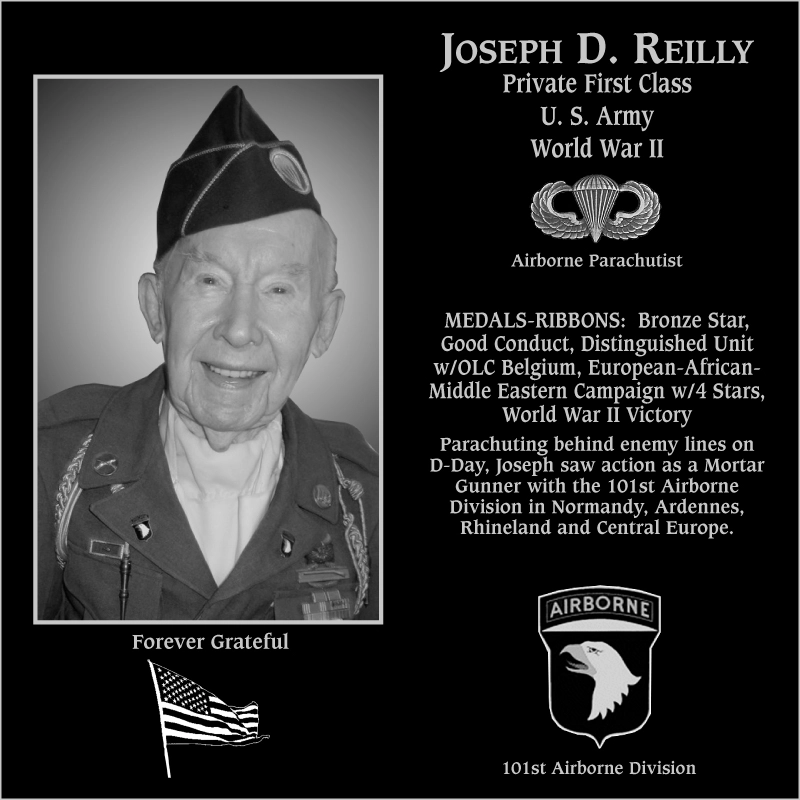
Joseph D. Reilly
| Era | WWII |
|---|---|
| Branch | U.S. Army |
| Rank | Private First Class |
| Military Decorations | Bronze Star |
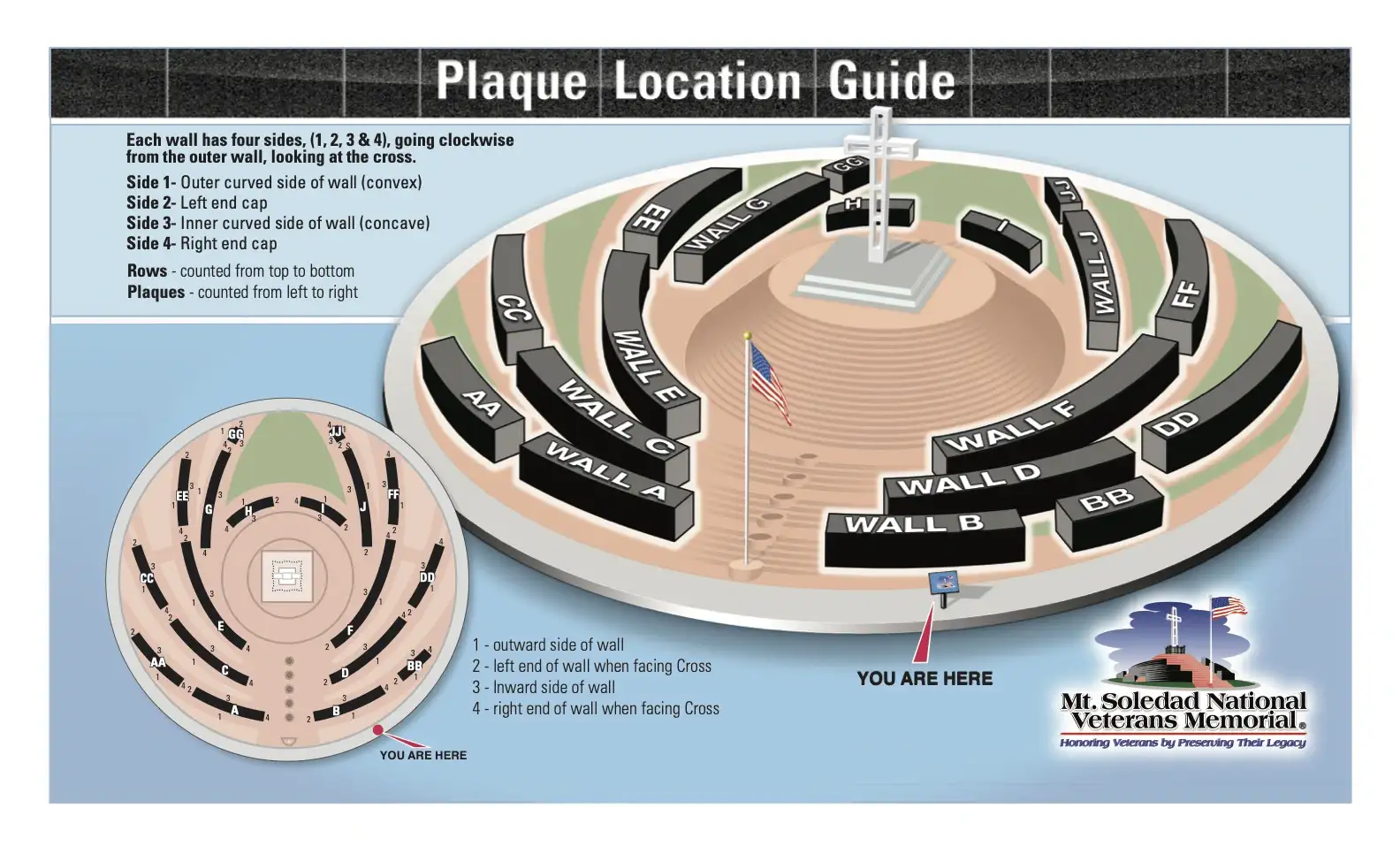
| Wall | G |
| Wall Side | 3 |
| Row | 3 |
| Plaque Number | 25 |
MEDALS-RIBBONS: Bronze Star, Good Conduct, Distinguished Unit W/OLC Belgium, European-African-Middle Eastern Campaign wI4 Stars, World War II Victory
Parachuting behind enemy lines on D-Day, Joseph saw action as a Mortar Gunner with the 101st Airborne Division in Normandy, Ardennes, Rhineland and Central Europe.
Private Joe D Reilly, a Janesville, Wisconsin native, jumped into the European Theater's biggest battles, as a paratrooper with the 101st Airborne. Born May 7, 1921, the oldest of two, Reilly graduated from Janesville High and went to work in a a defense factory in Delavan. But in March 1943, Reilly's patriotism,even when he had a deferment from the draft, drove him to give up the promised safety, enlisted in the Army and parachuted into the greatest battles of the 20th Century.
Training was tough. It had to be to prepare him for the rigors of his first day---his longest day---in battle, the D-Day Invasion of Normandy, France on June 6, 1944. Reilly joined the 541st parachute regiment for advanced training and maneuvers, as a private first class 81-mm mortar gunner at Camp McCall, N.C. He boarded a troop ship in February of 1944 bound for Europe as a replacement for an airborne unit. After 3 more weeks of training in Belfast,Ireland and troop train ride to Southern England, Joe first saw the sign of his new unit - a Screamin' Eagle patch. Joe was now with the 101st Airborne Division,assigned to Headquarters company, 3rd Battalion, 501 Parachute infantry. More vigorous training followed.His unit was drilled to memorize the rivers, locks, roads, rail lines and villages they would encounter since they were not permitted to draw nor carry maps.
It was 1:40 a.m June 6, 1944 hours before the D-Day invasion when Joe, along with 160 lbs of gear, hit the ground 4 or 5 miles inland from Utah Beach. A few clicks from his "cricket" here and there,and he was soon joined by 8-10 troopers and he could now take the safety off M-1 rifle. At 3:20 a.m. Joe's long day really began; it didn't end until midnight. They would be among the first Allied troops in battle. parachuting into Nazi occupied France along the coast near Normandy.Their objective was to help knock out Nazi defenses and clear an easier path for thousands landing on the beaches a couple hours later.
After 6 weeks in Normandy, and a furlough to England, Joe was now jumping into Holland, and back into combat, Sept. 17, 1944, in a daytime jump operation named "Market Garden". The Market Garden mission in Holland was for 2 American airborne divisions, including Joe's, and a British airborne division to secure bridges across canals and rivers, like the Rhine, before the Germans had a chance to destroy them delay the Allied advance. With Dutch intelligence and some tough fighting, Joe's division held the bridge near Eindhoven. The 101st liberated many Dutch villages, like Eerde, but it was never easy.
On Dec. 16, 1944 began what would become one of the most massive, hardest fought battle of the European war- The Battle of the Bulge. Joe was right in the heat of that battle, fighting nearly to death in the infamous, besieged town of Bastogne. He was a "Battered Bastard of Bastogne". Joe's division fought right thru Christmas and on Dec. 26, Joe heard tanks that didn't sound German. To his great relief, they were Gen.Patton's tanks. History records Gen. Patton had a lot of respect for the airborne troops, especially at Bastogne. Retreat and capture were his greatest dislikes and the 101st had done neither against great odds and still saved the town. For their determined fight to save Bastogne, the 501st Parachute Infantry and 101st Airborne Division were presented a special unit citation by General Dwight D. Eisenhower. Joe received a Bronze Star for his heroic, stubborn fighting during the siege. After Bastogne, it was off to Hitler's "Eagle's Nest "in Berchtesgaden to round up what was left of the Nazi Command and hold them for the Nuremberg trials.
Joe found the love of his life in England while on a seven day furlough. Eileen Campbell and Joe met at an amusement park in Manchester. He won her heart and after courting throughout the war, the two were engaged in September 1944 just months before Bastogne. In March 1945, they finished the extensive paperwork needed to get married. They would go on to get married on March 31, 1945 in England. Though the war ended on his birthday, May 7, 1945, he would not be officially discharged until Dec. 31, 1945. By this time Eileen was six months pregnant. He shipped home in November and Eileen had their 1st daughter on Jan. 4, 1946, but he did not get to see them until Eileen was able to get passage to America, arriving on Mother's Day,1946, aboard the final voyage of the Queen Mary.
Today Joe stays very active and shows no signs of slowing down. He travels across the country for the International Association of Machinists and Aerospace Workers, and goes back to Europe with The Greatest Generation Foundation. He has been on TV Interviews with Brian Hansen from NBC, Larry King Live When he's not abroad, Joe relaxes at his home in Santee tending to his many plants, fruit trees and spends his days with his 2nd wife Teresa.
Plaque Wall Map