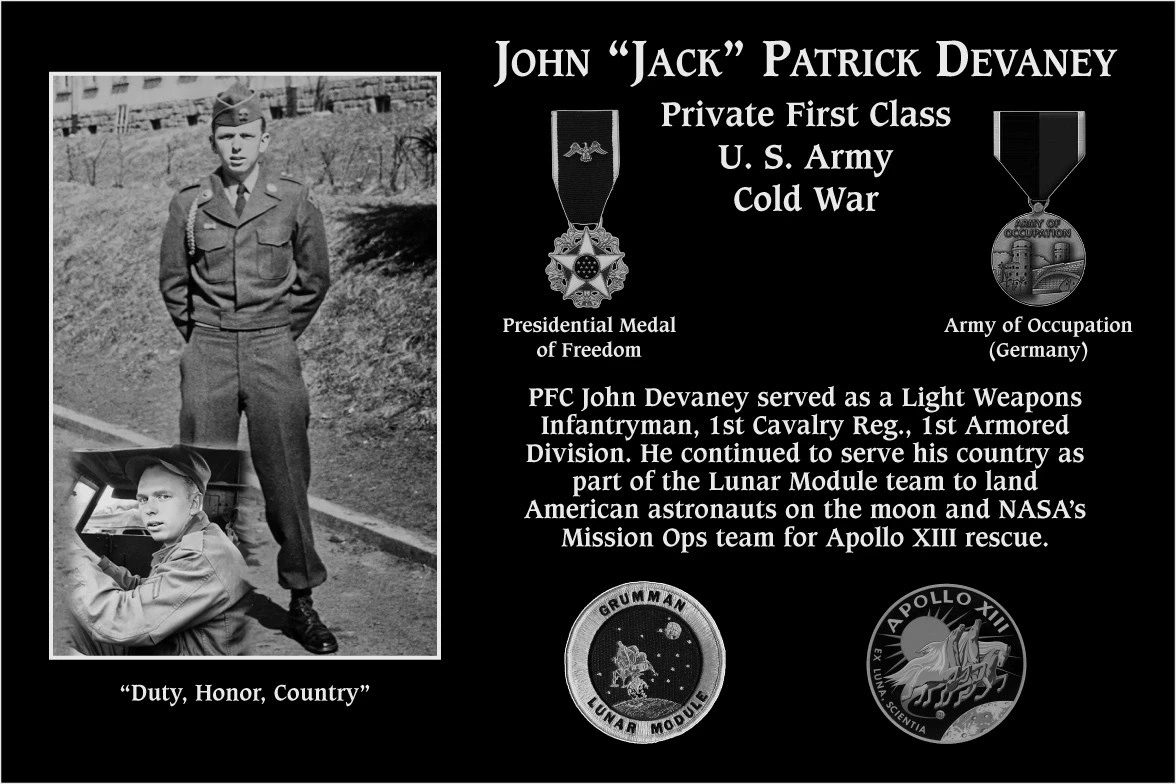
John "Jack" Patrick Devaney
| Era | Cold War |
|---|---|
| Branch | U.S. Army |
| Rank | Private First Class |
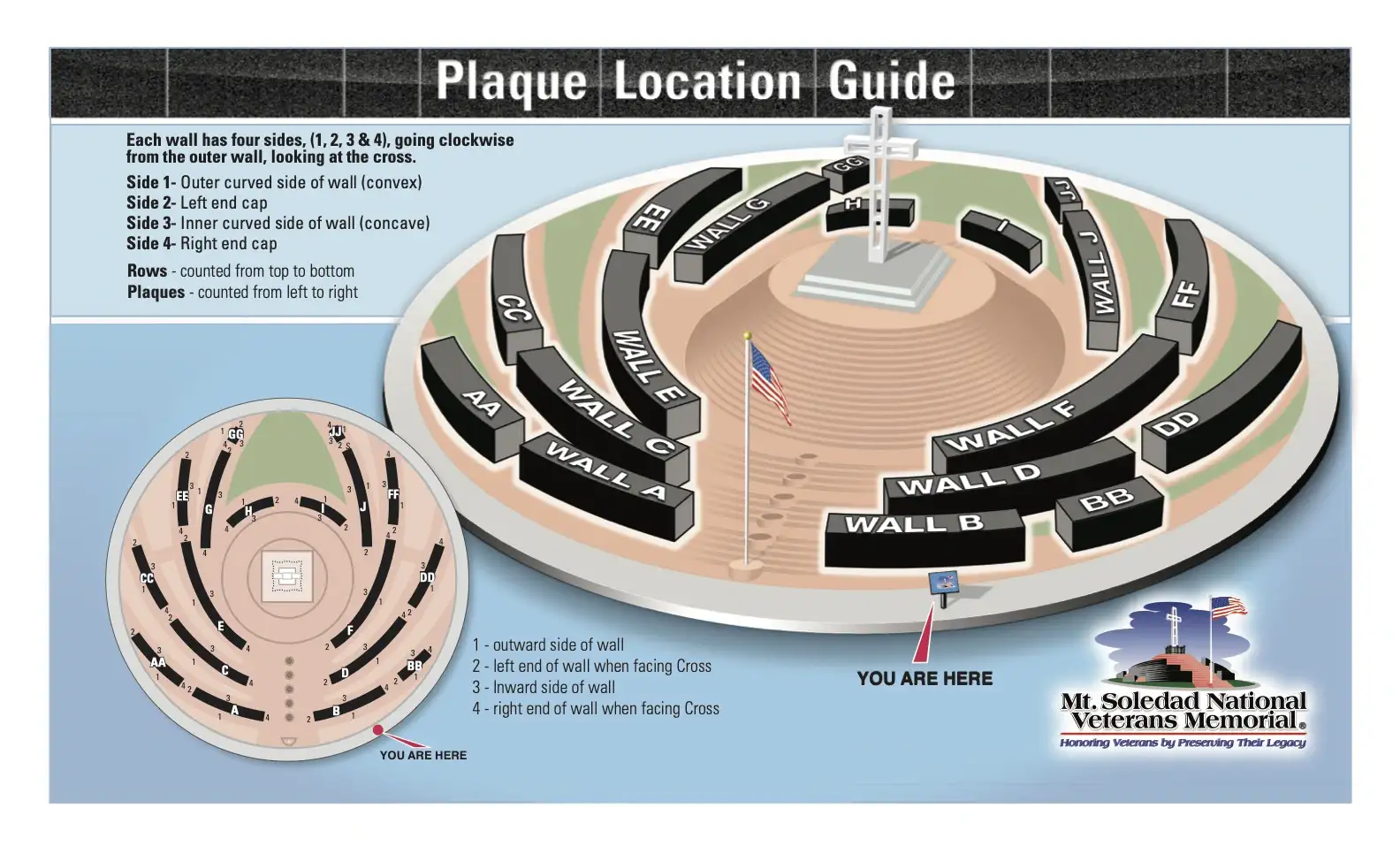
| Wall | CC |
| Wall Side | 4 |
| Row | 4 |
| Plaque Number | 3 |
Jack Devaney was born October 25, 1934, in Brooklyn, New York, one of four siblings born to Irish immigrants. He enlisted in the U.S. Army at Fort Dix, New Jersey September 22, 1954, and served at the U.S. Army base in Büdingen, Germany, known as Armstrong Barracks. The Barracks was primarily home to cavalry units, most notably the 1st Squadron, 1st Cavalry Regiment (1-1 CAV), which was the Division Cavalry for the U.S. Army's 1st Armored Division. Jack served there till August 15, 1956, and then transferred to the U.S. Army Reserve. He continued his service in the Reserves until August 31, 1962, when he was honorably discharged.
Jack served just a total of 6-years during the Cold War yet his career and significant contributions to the United States were only just beginning. Following his Army service, Jack worked on the Talos radar system at Sperry Corporation. Sperry had a major presence on Long Island, NY before moving to a large, government-built plant in Lake Success, Nassau County, during World War II. His work on the Talos radar took him to work on Navy ships such as the USS Missouri and others. From there, Jack continued his engineering career at Grumman Aerospace Corporation where he was a member of the esteemed Lunar Module team. The LM was a crucial piece of technology that made the first lunar landings possible. Jack, as a member of the LM team, had a significant impact as they contributed to the national effort to land American astronauts on the moon and return them safely to earth.
While working in systems analysis and technical support for Grumman Aerospace, Jack remembered how much precision was needed in a time before modern computers. He, along with several others, played a pivotal role in the safe return of the Apollo XIII astronauts. When Apollo XIII experienced a catastrophic explosion on April 13, 1970, aboard the spacecraft’s service module forcing the lunar module landing to be aborted, Jack, along with several other Grumman scientists, worked alongside NASA Mission Operations Team, to guide the crew to a safe return. The three astronauts, James A. Lovell Jr., Fred W. Haise Jr., and John L. Swigert, used the Lunar Module (LM) as a "lifeboat" to return to Earth, which they did safely on April 17. The mission, though unable to land on the Moon, is considered a "successful failure" due to the incredible rescue efforts by the crew and Mission Control. Jack would later meet, and be personally thanked by, Fred Haise, Jr. on an official visit with the Grumman Aerospace team.
At an April 18, 1970, ceremony in Houston, Texas President Richard Nixon presented the Presidential Medal of Freedom to the Apollo XIII Mission Operations Team, including Jack Devaney and the engineers from Grumman Aerospace. President Nixon is quoted as saying, "Finally, your mission served your country. It served to remind us all of our proud heritage of a nation. To remind us that in this age of technicians and scientific marvels that the individual still counts. That in a crisis, the character of a man, or of men, will make the difference."
Jack Devaney lived a life of a humble, yet true American hero. On behalf of a grateful nation, Mt. Soledad Board of Trustees thanks his wife Mary, their children John, Kevin, Robert, and Anne Marie, and their extended family for his service. We honor Jack’s life and his incredible contributions to the U.S. Army, NASA space missions, and the United States of America.
Plaque Wall Map