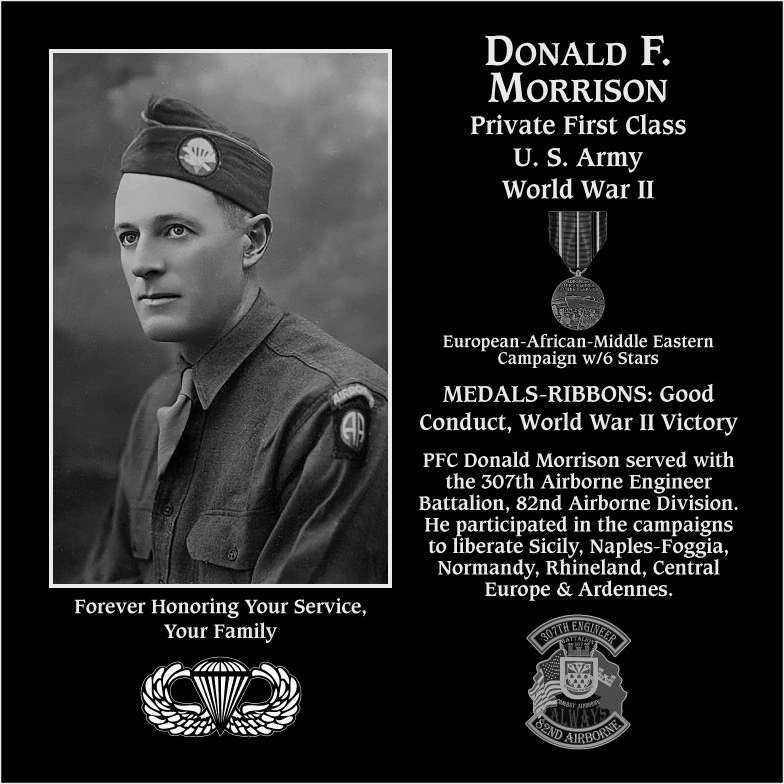
Donald F. Morrison
| Era | WWII |
|---|---|
| Branch | U.S. Army |
| Rank | Private First Class |
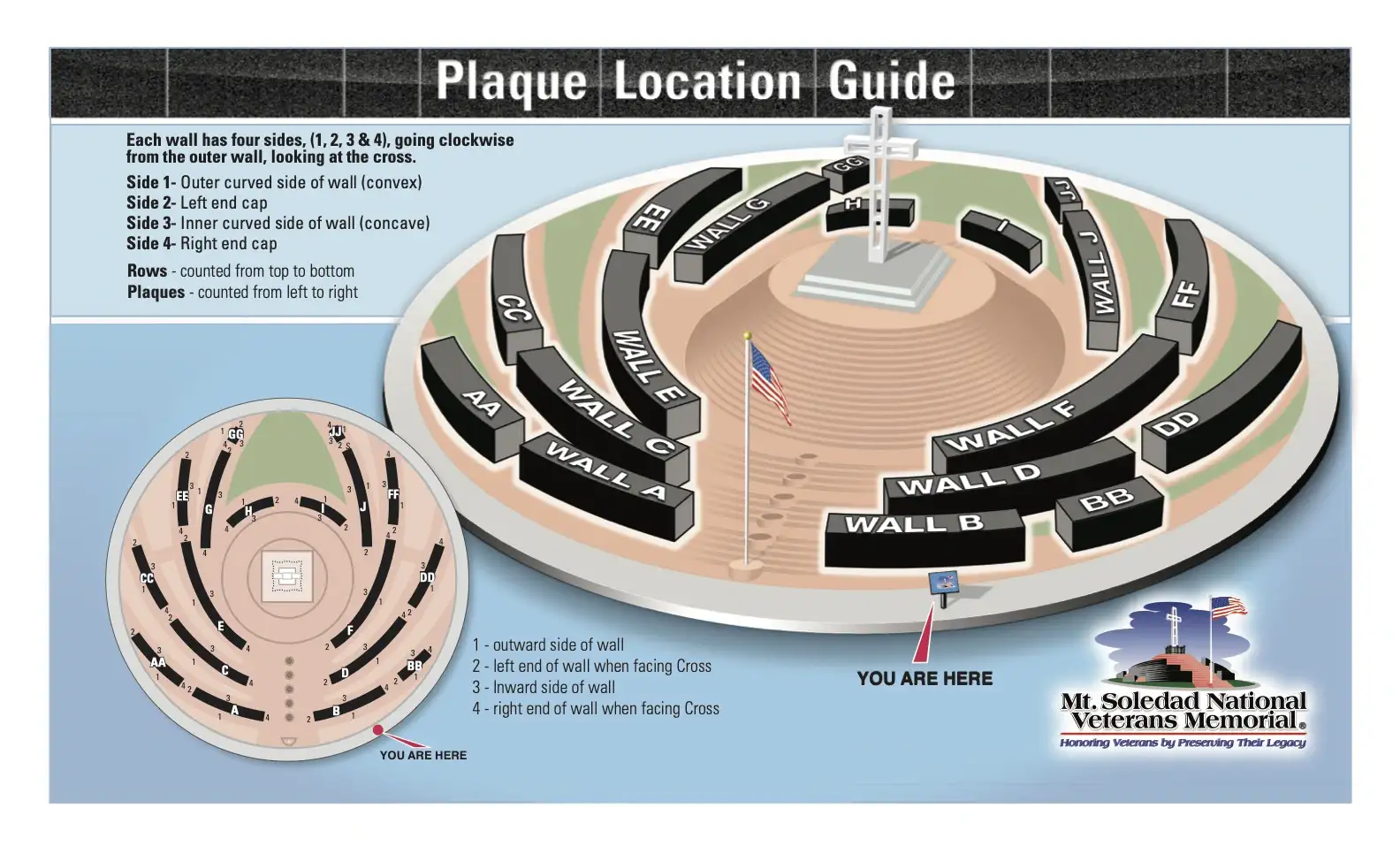
| Wall | CC |
| Wall Side | 1 |
| Row | 2 |
| Plaque Number | 6 |
Don enlisted in the U.S. Army’s 82nd Airborne Division in December 1942, serving as a combat engineer with the 307th Airborne Engineers Battalion. This role demanded both physical endurance and technical skill, as he was responsible for constructing and demolishing crucial infrastructure under combat conditions. He began his overseas journey in North Africa, where he trained and prepared for the intense campaigns ahead.
His first major operation took him to Sicily, where he contributed to the initial Allied assault on Axis forces in Europe. This operation marked the beginning of a series of pivotal campaigns that would shape the outcome of the war. Don's battalion was later involved in the invasion of Italy, playing a critical role in liberating Naples during the Naples-Foggia campaign. Here, as part of the forward movement through Italian terrain, his battalion expertly built bridges and cleared mines, creating pathways for troops and vehicles while securing vital supply lines.
In June 1944, Don’s journey brought him to the Normandy invasion, one of the war's most iconic and grueling battles. Landing at Omaha Beach, he and his fellow engineers faced fierce opposition, working relentlessly to clear obstacles, dismantle beach defenses, and open routes for advancing Allied forces. This work was perilous, as they were often under direct enemy fire, and it exemplified the courage and resilience for which the 82nd Airborne Division was renowned.
Following Normandy, Don’s battalion pressed on through France and Belgium, reaching the Ardennes forest by winter. In the brutal cold of the Battle of the Bulge, Don endured the freezing conditions, often sleeping in snow-covered foxholes. As the enemy launched counteroffensives, he and his comrades held their ground, maintaining crucial supply routes and fortifying positions to support the Allied advance.
By early 1945, the 82nd pushed into the Rhineland and continued into Central Europe. Each step brought new challenges, as Don’s battalion faced destroyed bridges, mined roads, and shifting battlefronts. Yet his commitment never wavered, and his actions were instrumental in supporting the division’s march into Germany, paving the way for the Allies’ final victory in Europe.
For his extraordinary service, Don was awarded the European-African-Middle Eastern (EAME) Theater Ribbon with six Bronze Stars, one for each major campaign he participated in, along with the Good Conduct Ribbon and Victory Medal. His legacy as a combat engineer with the 82nd Airborne exemplifies the valor, endurance, and skill that characterized the Greatest Generation.
Plaque Wall Map