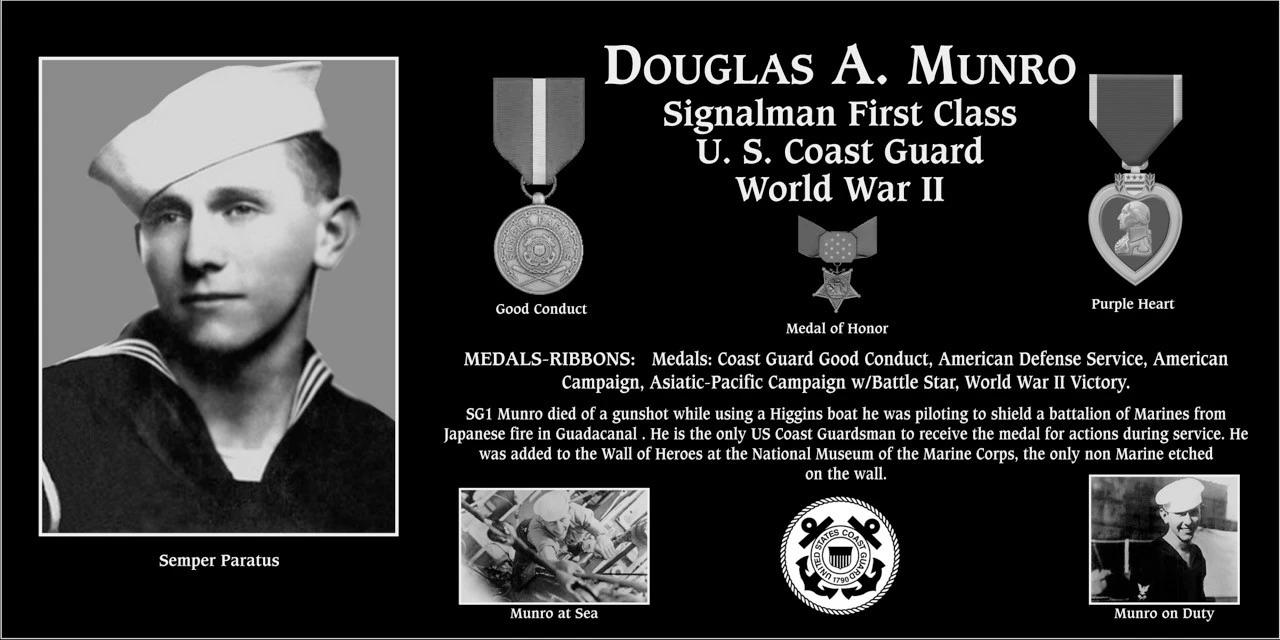
Douglas A. Munro
| Era | WWII |
|---|---|
| Branch | U.S. Coast Guard |
| Rank | Petty Officer First Class |
| Military Decorations | Medal of Honor Purple Heart |
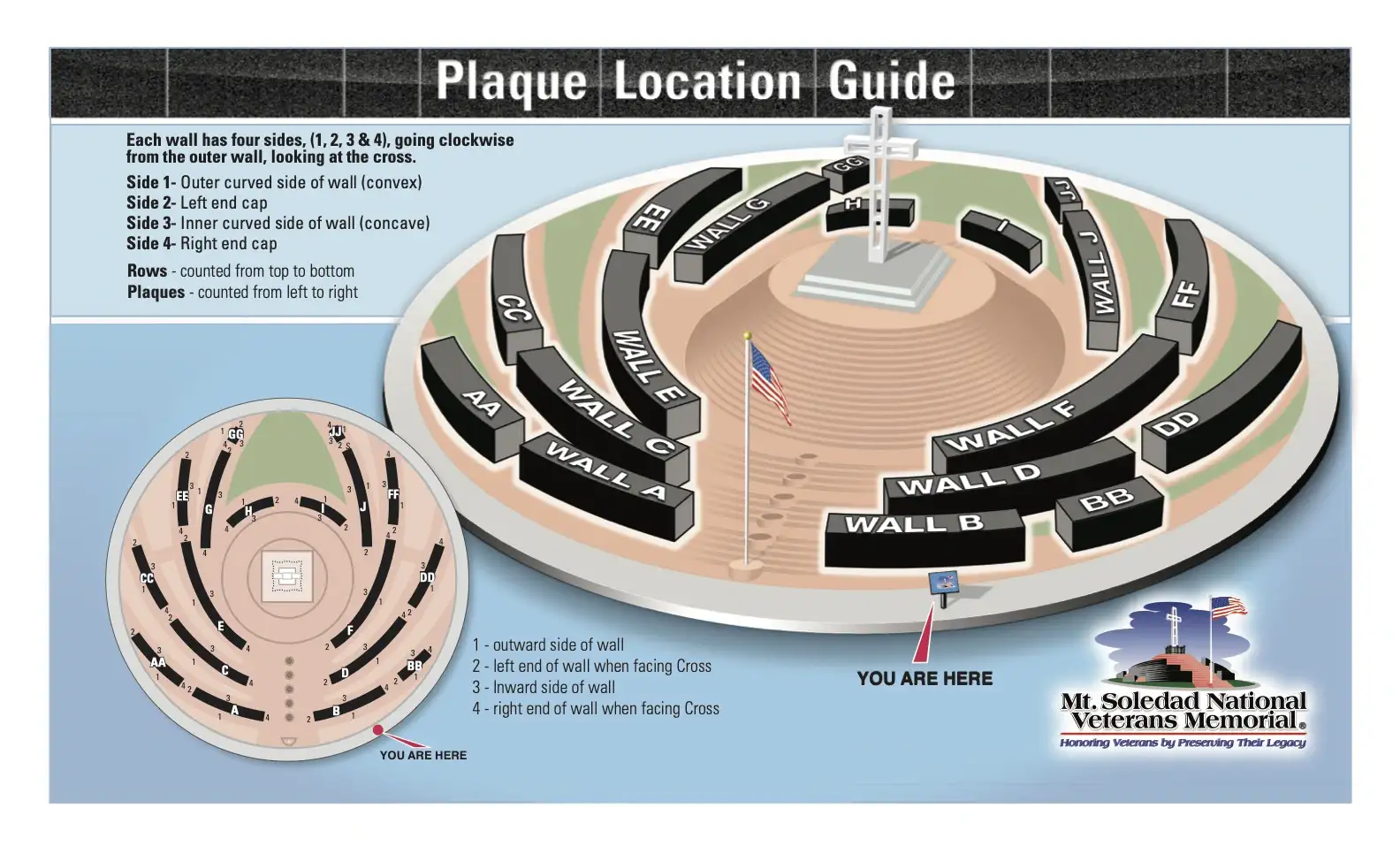
| Wall | J |
| Wall Side | 3 |
| Row | 4 |
| Plaque Number | 13 |
MEDALS-RIBBONS: Purple Heart, Medal of Honor, Good Conduct, Coast Guard Good Conduct, American Defense Service, American Campaign, Asiatic-Pacific Campaign w/Battle Star, World War II Victory.
SG1 Munro died of a gunshot while using a Higgins boat he was piloting to shield a battalion of Marines from Japanese fire in Guadacanal. He is the only US Coast Guardsman to receive the medal for actions during service. He was added to the Wall of Heroes at the National Museum of the Marine Corps, the only non Marine etched on the wall.
Signalman First Class Munro, the son of an American father and British mother, moved to South Cie Elum as a child. Shortly before the outbreak of W.W. II, he joined the Coast Guard explaining to his sister, because they primarily saved lives. In September of 1941, after the Danish Government in Exile requested the United States protect Greenland, the U.S. Coast Guard seized the Norwegian sealer Buskoe with Nazi agents on board. The seizure became the first naval capture of W.W. II. In November, the Coast Guard was ordered to operate as part of the Navy. In September 1942, SFC Munro found himself assigned to Navel Operating Base Cactus at Lunga Point, Guadalcanal, from which small boats were operated during the Campaigns to wrest the island from the highly fortified Japanese forces. During the second battle of the Matanikau River, SFC Munro was designated as the Officer-in-Charge of 24 Higgins boats. On 27 September 1942, Munro planned and led the evacuation of a battalion of some 500 Marines commanded by Col. Lewis B. (Chesty) Puller trapped by Japanese forces. Puller and his signalman were able to reach the USS Monnsen which provided Navel gunfire that managed to clear a narrow corridor from the Marines position to the beach. Using the Monnsen’s signal lamp, Puller ordered the Marines to fight their way to the shore. Munro volunteered to lead the extraction of the trapped Marines and was placed in charge of two landing craft tank (LCT) and eight Higgens boats. As the boats approached the recovery points, they came under heavy fire from the Japanese from the ridge abandoned by the Marines. With Japanese troops moving against the beach, Munro piloted his boat closer to shore to act as a shield. Munro used a .30 caliber machine gun aboard his landing craft to suppress Japanese fire allowing the other boats to recover Marines. Though the initial extraction was successful, one of the LCTs became grounded on a sandbar. Munro directed the other LCT to help extricate the grounded vessel as he maneuvered his own boat to shield the Marines from Japanese shore fire. The LCT was ultimately freed and the boats resumed their withdrawal. During this time, Munro was shot in the base of his skull, losing consciousness. He briefly regained consciousness after the successful completion of the extraction and out of range of enemy fire. His dying words were, "Did they get off?" Boatmate SFC Ray Evans said later that "... seeing my affirmative nod, he smiled with that smile I knew and liked so well, and then he was gone." Colonel Puller recommended SFC Monro for the Medal of Honor which was awarded May 24. 1942. SFC Monro is currently the only Coast Guardsman to have been awarded the Medal of Honor and the only non-Marine enshrined on the Wall of Heroes of the National Museum of the Marine Corps.
Plaque Wall Map