James E. Verdieck
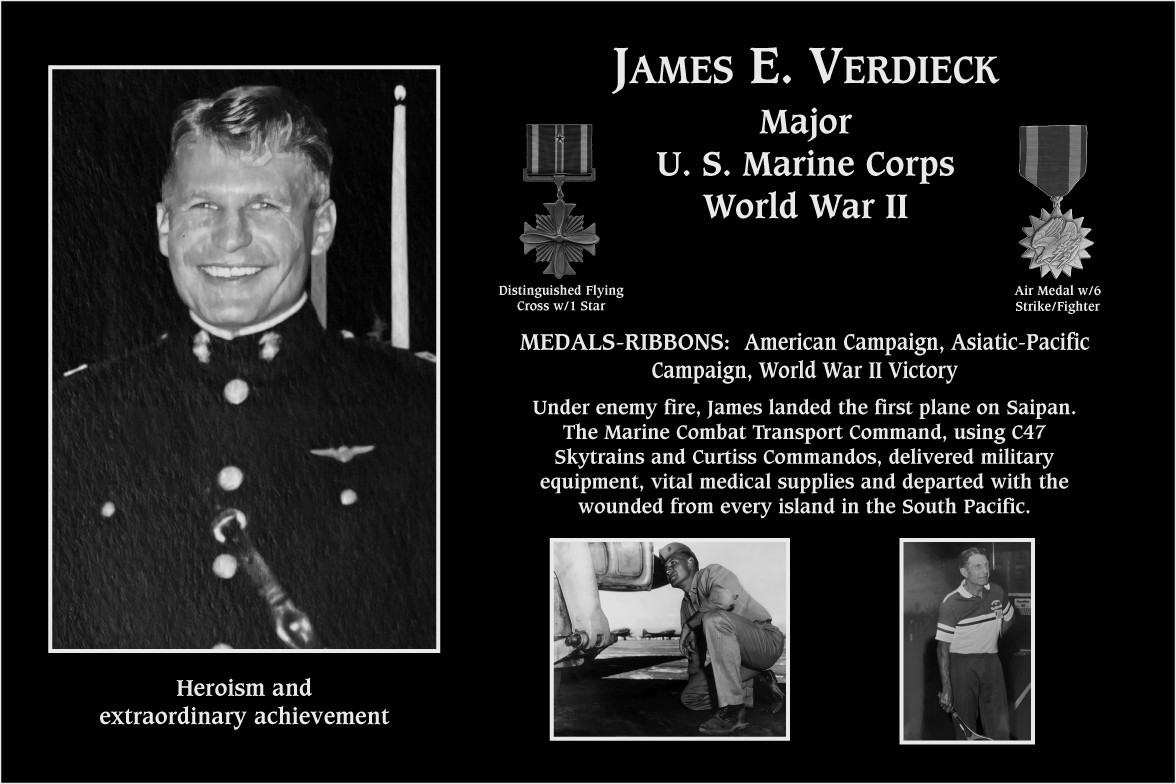
| Era | WWII |
|---|---|
| Branch | U.S. Marine Corps |
| Rank | Major |
| Military Decorations | Distinguished Flying Cross |
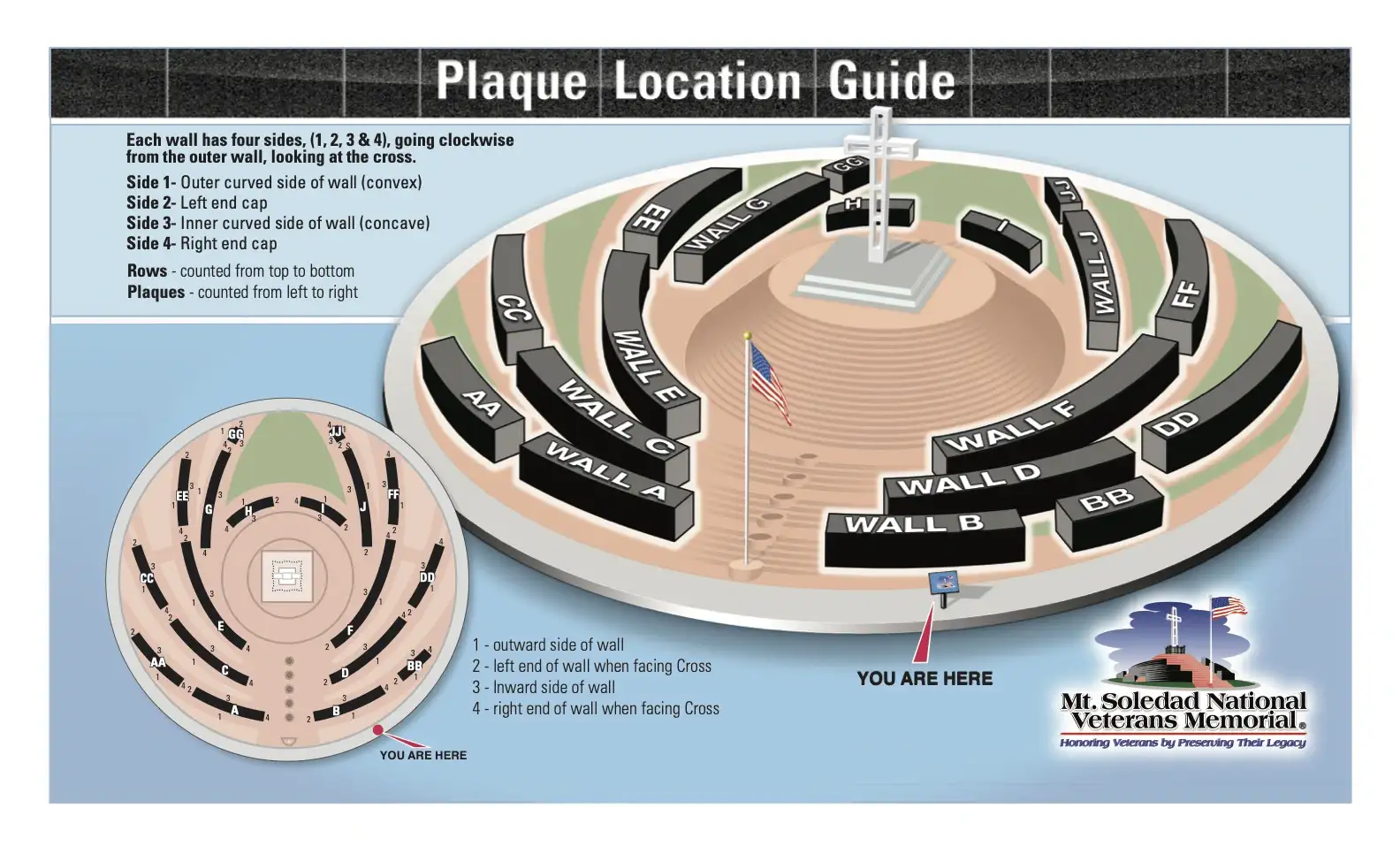
| Wall | AA |
| Wall Side | 4 |
| Row | 3 |
| Plaque Number | 2 |
What makes a life not just ordinary, but extraordinary? It is the extra effort a person brings to life through mindset and action—choices that elevate someone from ordinary to extraordinary. That was our grandfather, Coach Jim Verdieck. He was born on June 9, 1919, in Colton, California. From a young age, Coach learned self-reliance and hard work as he helped support his mother and two sisters. During the early years of the Great Depression, my grandfather earned money selling newspapers. Competition was fierce, and he quickly learned that to be successful, he had to be the first to a customer’s door. That was where he learned to hustle. When he was just eleven years old and times became too difficult for his mother to feed four mouths, my grandfather moved to a dairy farm to live with his uncle. There, he earned fifty cents a day cutting corn—roughly eleven dollars in today’s economy. By age fourteen, he was able to return home to his mother and sisters, though he still needed to work. Despite being underage, he was allowed to join the National Guard, earning four dollars for each meeting he attended. Hard work was nothing new to my grandfather. In high school, he played football, basketball, baseball, and ran track. He earned varsity letters in all four sports every year, making him the only student at Colton High School to earn twelve varsity letters. During the summers, he worked as a lifeguard at the local swimming pool and even worked in mines in Arizona.
After graduating, my grandfather attended San Bernardino Junior College, where he continued to excel in athletics, becoming a standout football player. He was selected as a Junior College All-American at center. His success earned him an athletic scholarship to Stanford University. He played first-string center during his junior year and served as a backup during his senior year, which included playing in the 1940 Rose Bowl against Nebraska. After graduating, my grandfather remained at Stanford for an additional year, earning a master’s degree in exercise physiology and studying heart-rate responses. Because of this work, he was deferred from the military draft at the start of World War II.
On December 7, 1941, when the Japanese bombed Pearl Harbor, my grandfather was working in the laboratory on his research project. He completed his master’s program and enlisted in July 1942. His operations officer was a former Stanford football teammate, and in a family interview, my grandfather recalled asking his friend to push him through training as quickly as possible. By February 1943, he had earned his commission and was flying C-46 transport planes in the Pacific, stationed at Miramar. My grandmother remembered the night he left. She sat in her car overlooking Point Loma late into the night, watching his red taillights disappear into the distance, unsure if she would ever see him again. Over the years, stories of my grandfather’s military service have been told and retold. There was the story of the baker who refused to give bread to my grandfather and his crew because it was reserved for Japanese prisoners, needless to say, the crew got their bread, or the bicycle that mysteriously came home on a plane, and then there were the coded letters he sent to his wife, Fepie, so she would know where he had flown. There was also the story of being the first in his squadron to fly into Saipan under enemy fire. His plane delivered critical military supplies and medical equipment, then carried twenty-two wounded soldiers and Marines back to safety. On another mission, my grandfather transported senior officers, “the brass,” which included generals and admirals, from the Marshall Islands to Pearl Harbor in preparation for their next major operation. They took off on a stormy night toward Johnson Island to refuel. Visibility was nearly nonexistent, and by morning, all they could see was open ocean and no island. Forced to break radio silence, my grandfather located his bearings and made a straight-in approach. A general watching over his shoulder asked, “How’s it going, Lieutenant?” “It’s going fine, sir,” he replied. He landed “smooth as butter” and was meritoriously promoted with the words, “Hell of a good landing, Captain!” My grandfather once said he never shot at anyone, but he couldn’t say that no one ever shot at him. On his first landing at Peleliu—the westernmost island of the islands of Palau and the final staging point before the Philippines—enemy one- and two-man tanks were still conducting raids. His aircraft wings were damaged by shrapnel during the approach. After temporary repairs, he flew the
damaged plane back to the mainland. After flying for the Marines and landing on every island in the South Pacific, "Coach" Verdieck was discharged as a Major on November 19, 1945.
But his extraordinary adventure did not end there….When our grandfather returned home to Southern California after World War II, he continued building his legacy of excellence, a legacy that would earn him the title of “Coach.” Coach married Fepie, and the two raised four children together in Redlands. Jim first worked at San Bernardino City College as a football and tennis coach. Jim’s coaching skills were recognized by the University of Redlands who then hired him as their football and tennis coach. This is where our grandfather became a legend. In 1946, in Coach’s first year at Redlands, his tennis team won the league title. This was just the beginning. In his 38 years as the Redlands tennis coach, he became the winningest tennis coach in collegiate history, with 921 wins and only 281 losses. His tennis teams won 35 Conference Titles and 15 National Titles. In 1956, his football team at Redlands went undefeated. His win-loss record is a true testament to his ability as a coach, considering Redlands did not offer athletic scholarships. Coach’s military training instilled a level of discipline and physical fitness in his players, something other universities could not keep up with. Coach trained his players that if they were to ever lose, it would not be because the opponent was in better shape. Coach’s winning record has never been equaled or surpassed. Thanks to his success at Redlands, our grandfather became known worldwide as “Coach.” His coaching skills were widely sought after; Coach was invited to conduct coaching clinics all over the world, including England, South Africa, Singapore, Japan, Australia, and New Zealand. Coach was voted into the NAIA Hall of Fame, the Intercollegiate Tennis Coaches Hall of Fame, the University of Redlands Hall of Fame, the Stanford Hall of Fame, the Colton High School Hall of Fame, and the Professional Tennis Registry Hall of Fame.
Biography as provided by his granddaughter:
Despite his numerous accomplishments in World War II and as a world-renowned tennis coach, our grandfather’s work ethic didn’t allow him to slow down in retirement. In 1984, Coach and Fepie moved to San Diego. Coach didn’t waste any time finding a tennis court and a team in need. Coach spent his time in retirement volunteering for more than a decade as the tennis coach at Poway High School. Coach was a true hero in every community he touched; his time was always spent inspiring those around him to achieve their best. Our grandfather was incredibly humble and always thought of how he could help others. In fact, in 2001, in the afternoon, when a fatal heart attack took Coach home to Heaven, he was on his way to coach a tennis match. Our grandfather’s overwhelming accomplishments in his extraordinary life are a reminder to all to work hard and to be the best version of yourself you can be. In addition to being a war hero and coaching legend, our grandfather was the ultimate family man. It’s no surprise Coach’s two sons, Doug and Randy, went on to become collegiate tennis champions; each played for Coach at Redlands and were a part of that history in the making. And of course, all nine of Coach’s grandchildren had the privilege of taking tennis lessons from him. In 2023, the University of Redlands unveiled a brand-new tennis facility in honor of Coach, naming it the Jim Verdieck Tennis Center.
To say our grandfather lived an ordinary life would be an understatement. His mindset and actions carried him through the Great Depression, to Stanford where he earned both an undergraduate and master’s degrees, then through a distinguished military career in which he received multiple Distinguished Flying Crosses and several Air Medals, and finally through a 38-year coaching career unlike any other. Each chapter of his life prepared him for the next—again and again elevating him from ordinary to extraordinary.
Plaque Wall Map