Charles N. Jones
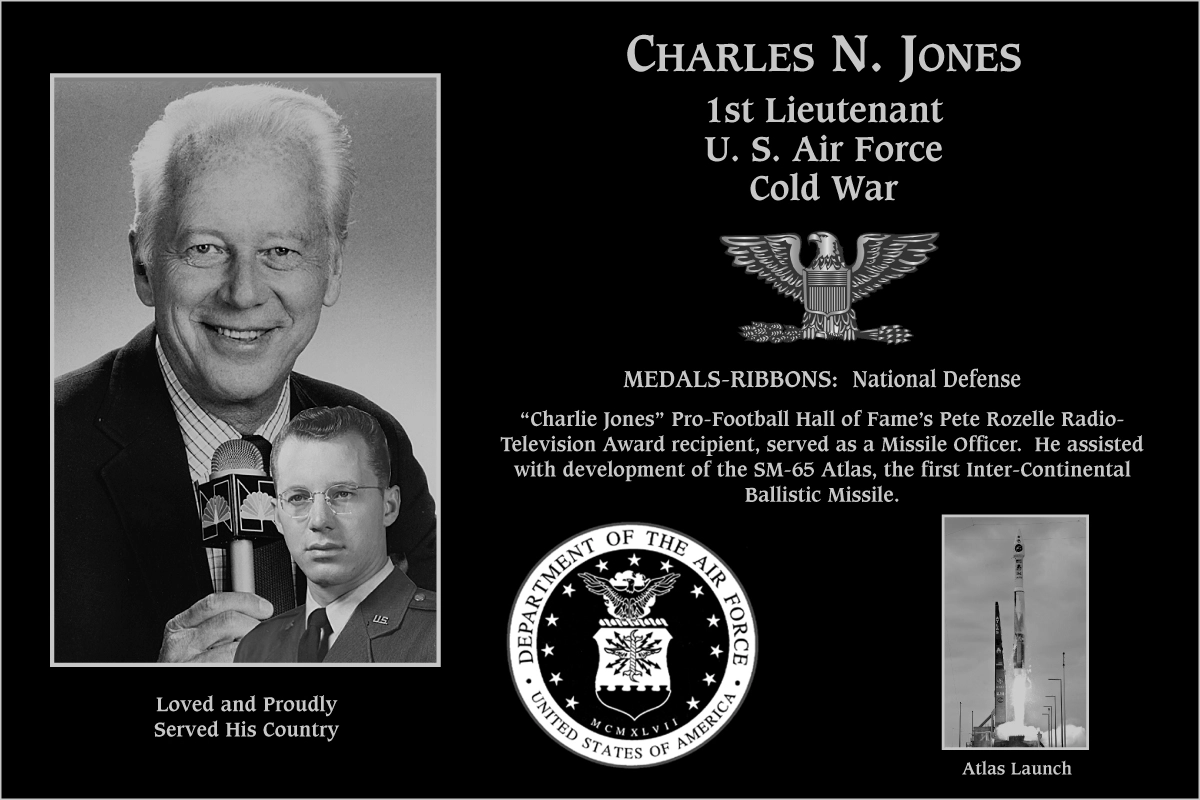
| Era | Cold War |
|---|---|
| Branch | U.S. Air Force |
| Rank | First Lieutenant |
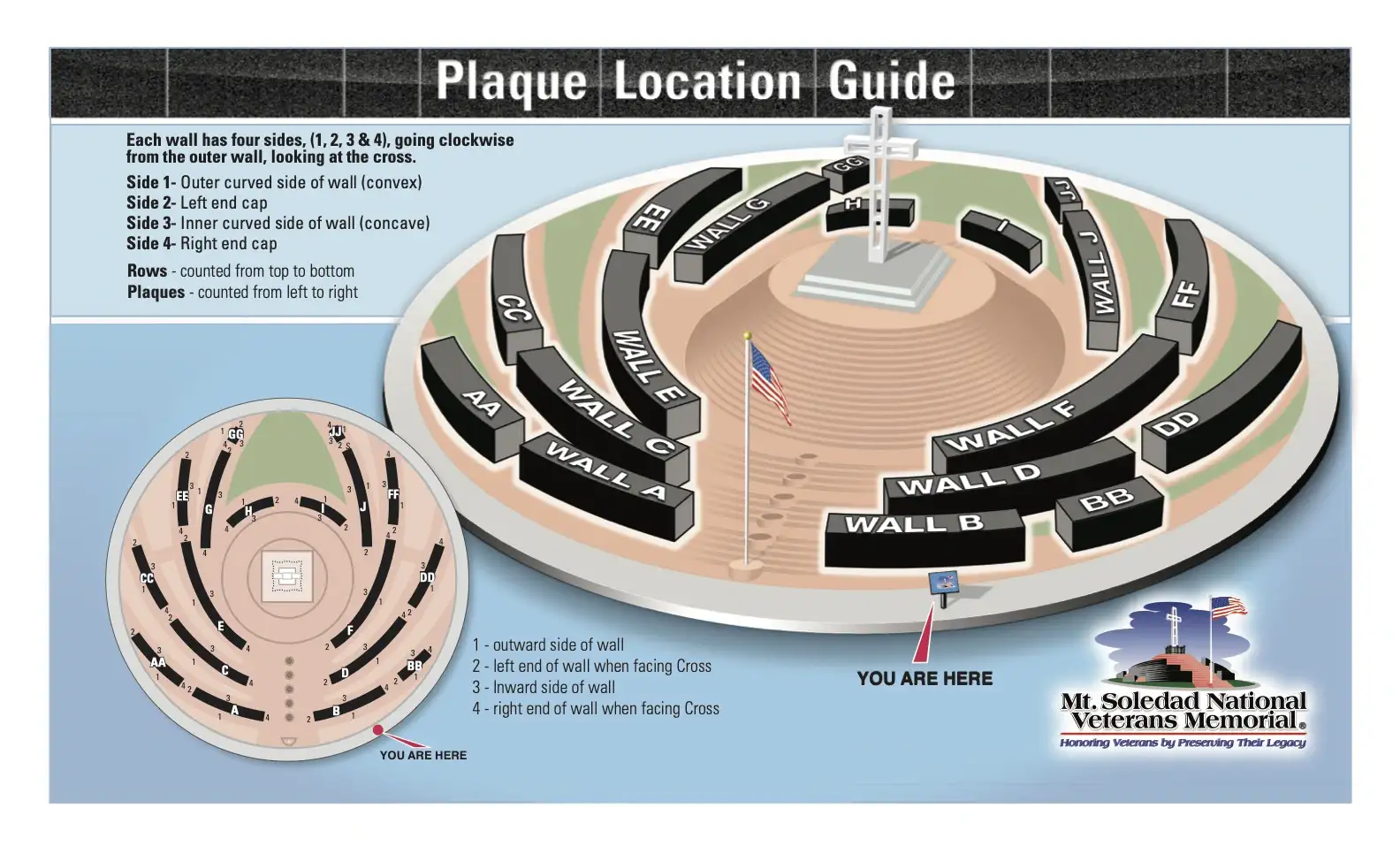
| Wall | I |
| Wall Side | 2 |
| Row | 2 |
| Plaque Number | 3 |
MEDALS-RIBBONS: National Defense
"Charlie Jones" Pro-Football Hall of Fame's Pete Rozelle Radio-Television Award recipient, served as a Missile Officer. He assisted with development of the SM-65 Atlas, the first Inter-Continental Ballistic Missile.
Charles N. Jones, born November 9, 1930 in Fort Smith, Arkansas to a doctor father and homemaker mother, grew up playing sports and started his broadcasting career calling his high school’s basketball games. Known as Charlie to all, he continued his education at the University of Southern California, where he played on its tennis team, and then the University of Arkansas Law School where he received his Jurist-doctorate degree.
Charlie then served in the U.S. Air Force from 1954-1955 stationed in San Diego where he was instrumental in saving millions of dollars in the first operational intercontinental ballistic missile developed for the United States named The Atlas Missile Program.
After the military, Charlie’s path took him a different direction and into his passion, sports broadcasting.
Charlie’s deep baritone voice served him well in the television and film industry. He spent over 45 years as a professional broadcaster with an unprecedented 38 years as an AFL and NFL play-by-play announcer. In his first assignment, he called the play-by-play for the first AFL game ever broadcast on television in 1960 and was on the broadcast teams for Super Bowl’s 1, 3 and 9; as well as calling 14 Fiesta Bowls from 1979-1995.
Charlie contributed to "ABC's Wide World of Sports" during his stint with ABC from 1960 to 1965. At NBC, Jones called 28 different sports in 25 foreign countries, including Major League Baseball for the Cincinnati Reds, Anaheim Angels, and Colorado Rockies. His love of golf and tennis made him a natural at commentating PGA & LPGA golf tournaments as well as Wimbledon & the French Open Tennis tournaments. Figure skating, gymnastics and formula one racing were many of his broadcasting accomplishments. And, his talent lent well to him telecasting three Olympic Games. Track & Field and Diving in Seoul, Korea, Swimming and Diving in Barcelona, Spain and Rowing and Canoeing in Atlanta, Georgia.
In 1973, Charlie won an Emmy for his work as writer, producer and host of the documentary, "Is Winning the Name of the Game?" He later co-wrote, co-produced and co-hosted the award-winning PBS series, "The American Frontier," with famed LA Rams football player, Merlin Olsen.
Charlie and television personality, Regis Philbin, co-hosted a weekly TV show named “Almost Anything Goes” from 1975-1976. The show almost defies description. Each week, three teams (each representing a particular USA town and consisting solely of members from the town) competed for money and prizes. The competitions varied from week to week and included bizarre obstacle courses, pie throwing contests, swing relays, and other humorous, crazy contests all to win prizes.
Charlie’s television and film credits are varied; always playing a reporter or newscaster; he appeared in McMillan and Wife, Quincy M.D., Rich Man Poor Man, Colombo, McCloud, and Ironside. Movie credits included; Without Limits, Superdome, Personal Best, Return of the Killer Tomatoes, Killer Tomatoes Strike Back, and Cutting Edge.
Charles N. Jones, born November 9, 1930 in Fort Smith, Arkansas to a doctor father and homemaker mother, grew up playing sports and started his broadcasting career calling his high school’s basketball games. Known as Charlie to all, he continued his education at the University of Southern California, where he played on its tennis team, and then the University of Arkansas Law School where he received his Jurist-doctorate degree.
Charlie then served in the U.S. Air Force from 1954-1955 stationed in San Diego where he was instrumental in saving millions of dollars in the first operational intercontinental ballistic missile developed for the United States named The Atlas Missile Program.
After the military, Charlie’s path took him a different direction and into his passion, sports broadcasting.
Charlie’s deep baritone voice served him well in the television and film industry. He spent over 45 years as a professional broadcaster with an unprecedented 38 years as an AFL and NFL play-by-play announcer. In his first assignment, he called the play-by-play for the first AFL game ever broadcast on television in 1960 and was on the broadcast teams for Super Bowl’s 1, 3 and 9; as well as calling 14 Fiesta Bowls from 1979-1995.
Charlie contributed to "ABC's Wide World of Sports" during his stint with ABC from 1960 to 1965. At NBC, Jones called 28 different sports in 25 foreign countries, including Major League Baseball for the Cincinnati Reds, Anaheim Angels, and Colorado Rockies. His love of golf and tennis made him a natural at commentating PGA & LPGA golf tournaments as well as Wimbledon & the French Open Tennis tournaments. Figure skating, gymnastics and formula one racing were many of his broadcasting accomplishments. And, his talent lent well to him telecasting three Olympic Games. Track & Field and Diving in Seoul, Korea, Swimming and Diving in Barcelona, Spain and Rowing and Canoeing in Atlanta, Georgia.
In 1973, Charlie won an Emmy for his work as writer, producer and host of the documentary, "Is Winning the Name of the Game?" He later co-wrote, co-produced and co-hosted the award-winning PBS series, "The American Frontier," with famed LA Rams football player, Merlin Olsen.
Charlie and television personality, Regis Philbin, co-hosted a weekly TV show named “Almost Anything Goes” from 1975-1976. The show almost defies description. Each week, three teams (each representing a particular USA town and consisting solely of members from the town) competed for money and prizes. The competitions varied from week to week and included bizarre obstacle courses, pie throwing contests, swing relays, and other humorous, crazy contests all to win prizes.
Charlie’s television and film credits are varied; always playing a reporter or newscaster; he appeared in McMillan and Wife, Quincy M.D., Rich Man Poor Man, Colombo, McCloud, and Ironside. Movie credits included; Without Limits, Superdome, Personal Best, Return of the Killer Tomatoes, Killer Tomatoes Strike Back, and Cutting Edge.
In retirement, he put his voice to paper and penned the non-fiction book "What Makes Winners Win," published in 1997, which made the New York Times Bestsellers List and in that same year he was honored with Pro Football Hall of Fame's distinguished Pete Rozelle Radio-Television Award for longtime exceptional contributions to radio and television. And in 2000, his alma mater, University of Arkansas inducted him into its Sports Hall of Fame for his outstanding achievement, accomplishments, and contributions in both amateur and professional sports that have brought honor, prestige, and fame to the state of Arkansas.
His graciousness, generosity and willingness to help people on the way up combined with his preparation, literacy and great love for family and sports made him who he was…..”The man with the golden voice”.
He loved what he did, always saying, “I have the best job in the world”.
Plaque Wall Map