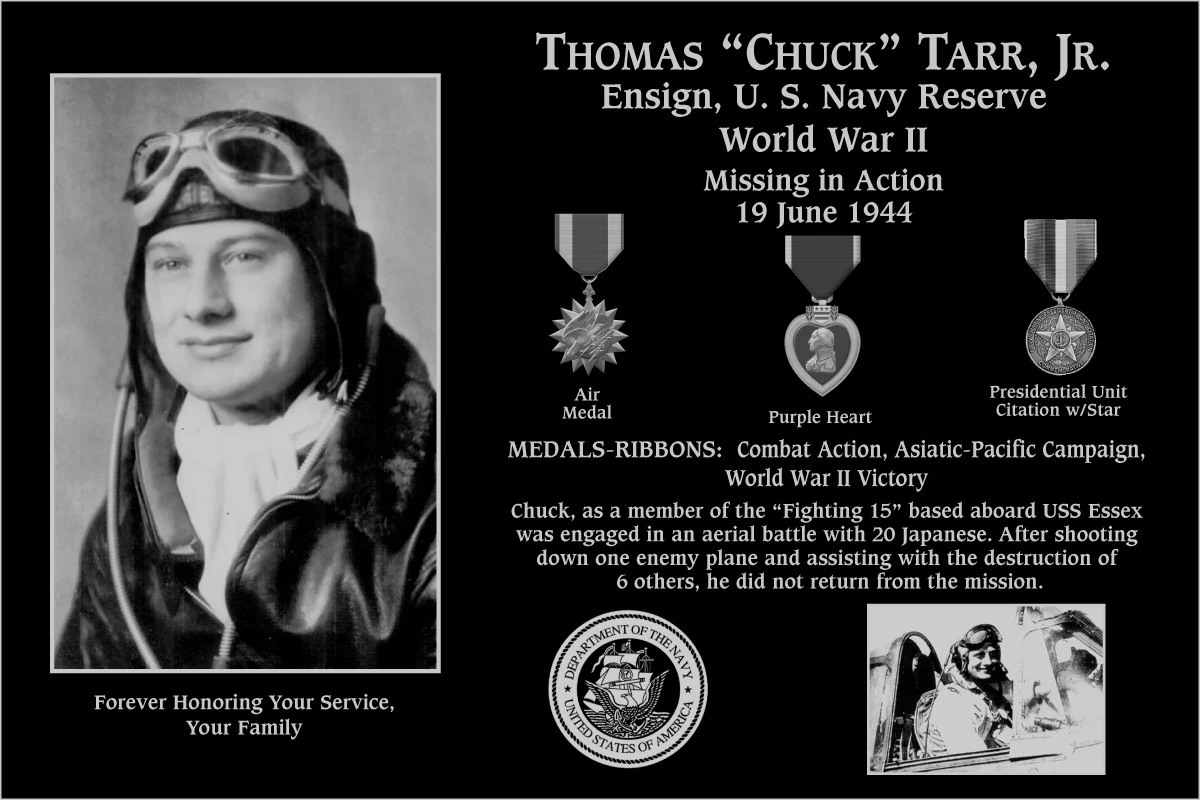
Thomas "Chuck" Tarr, Jr.
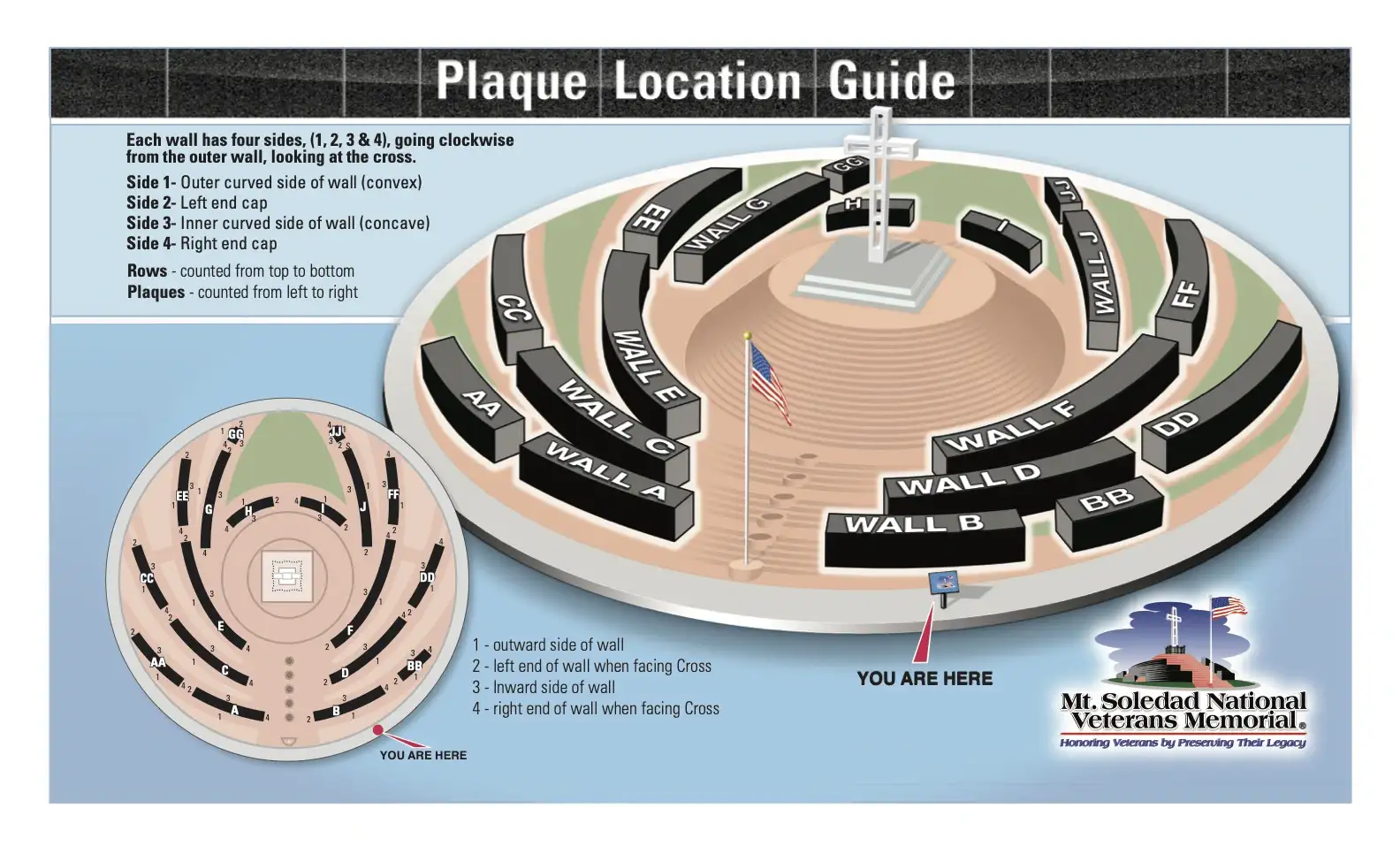
| Era | WWII |
|---|---|
| Branch | U.S. Navy |
| Rank | Ensign |
| Military Decorations | Purple Heart |
| Wall | G |
| Wall Side | 3 |
| Row | 4 |
| Plaque Number | 23 |
 Thomas Tarr, Jr.


 Thomas Tarr, Jr., known as “Chuck”, was born Nov. 16, 1920, in McLouth, Kansas. He was the seventh child of Thomas and Ellie Tarr. After graduating from Topeka High School, he moved to New York, where his older brother, Roy, resided. Chuck

 was employed by Grumman Aircraft's New York City plant until joining the Navy in
1942. Roy was employed by the Yankee baseball organization as bullpen catcher and scout. According to the oldest brother, Pete, Chuck accompanied Roy to a Yankee practice session and was invited to hit a few balls. After hitting a few out of the
park, the surprised Yankee coach expressed interest in Chuck but, because of his Navy commitment, Chuck was unavailable.

 Chuck received his commission at Corpus Christi, Texas in 1943 and received orders to join VF-1S, nicknamed the “Fabled Fifteen”.
Flying off the USS Essex,
This squadron destroyed 313 enemy planes in the air and an equal number on the ground during their six and one-half month tour, including the highest victory score of any one day with 68.5 destroyed on June 19, 1944, during the Battle of the Philippine Sea. Battle of the Philippine Sea, aka, Marianas Turkey Shoot. At dusk on June 19, 1944, Lt. Cmdr. C.W. Brewer with Chuck (Ensign Thomas Tarr, Jr. USNR) as his wingman, led his fighters in a last sweep over Orote Field, Saipan Island, Guam. Suddenly, 16 Japanese “Zekes” jumped the Hellcats who were greatly outnumbered in the twilight of early evening. Neither Brewer nor Chuck were ever seen again. In this epic battle, the total Japanese losses were 426, compared to 29 U.S. planes. A third of the pilots
of those 29 planes were saved. Unfortunately, Chuck was not one of them.
(Sources: Alan Fick, Aviation Quarterly, 3’d Quarter 1979 issue and Bili Coombes,
The Dispatch magazine, Volume 23, Number 3, Fall 1998 edition.)
Plaque Wall Map