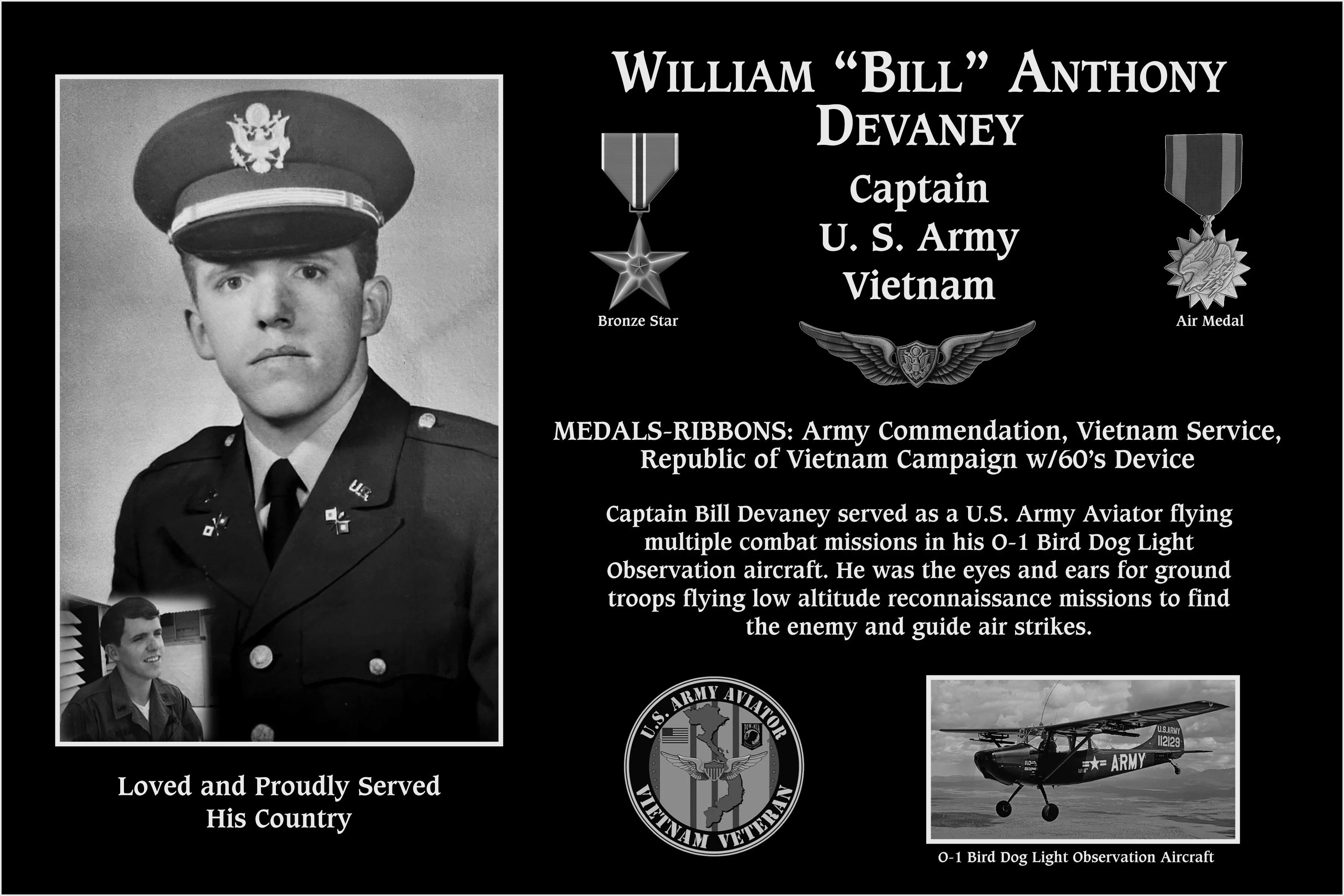
William "Bill" Anthony Devaney
| Era | Vietnam War |
|---|---|
| Branch | U.S. Army |
| Rank | Captain |
| Military Decorations | Bronze Star |
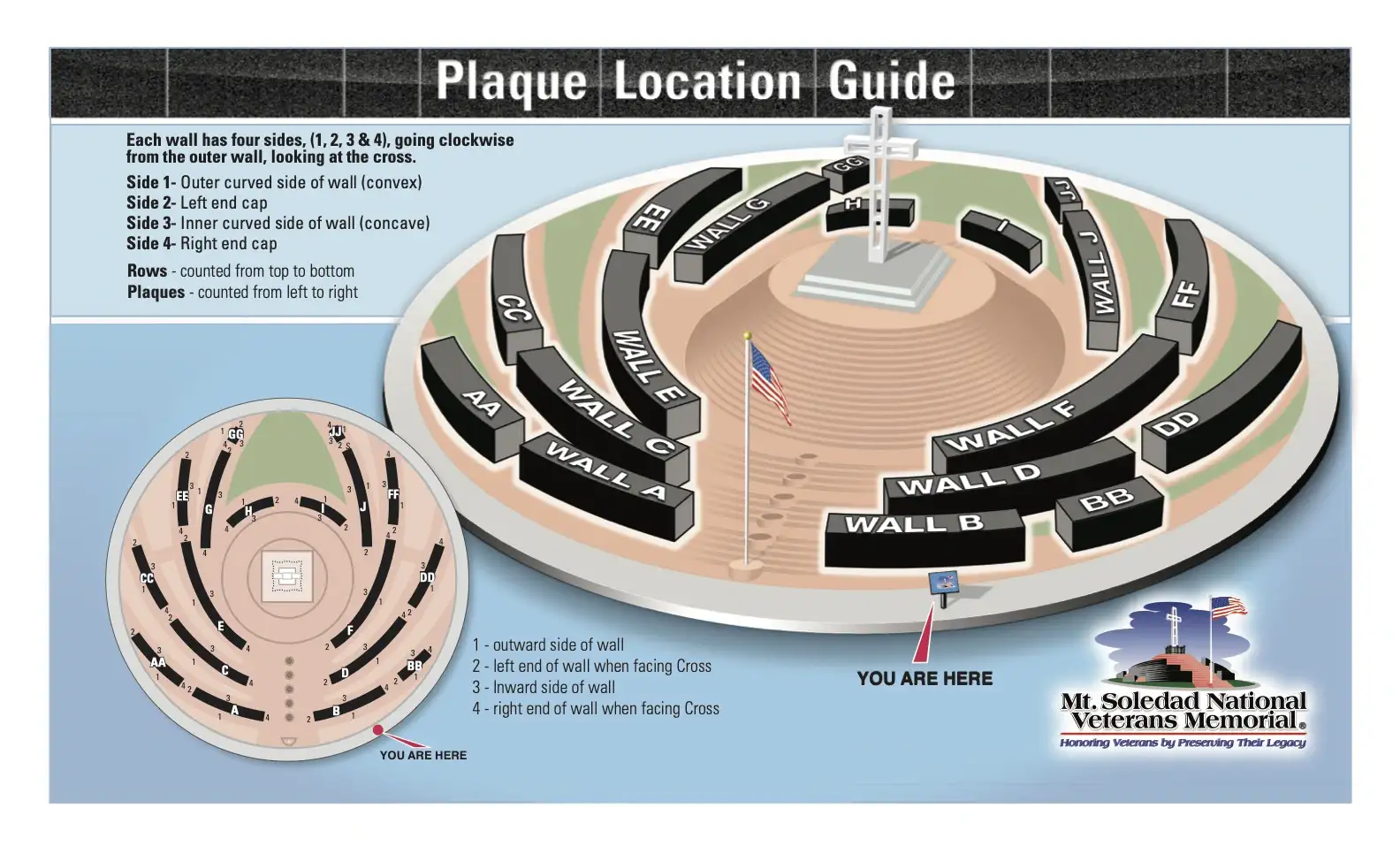
| Wall | CC |
| Wall Side | 4 |
| Row | 5 |
| Plaque Number | 1 |
Bill Devaney was born November 17, 1945, in Brooklyn, NY. He joined ROTC at Loyola and began his military service on February 7, 1968, at Fort Meade, Maryland. Trained as a pilot, he earned his Army Aviator Badge “WINGS.” He served 3 years, 6 months, 3 days in the U.S. Army and from March 23, 1969 - March 22, 1970, in Vietnam. CPT Devaney was an elite member of the Bird Dogs, where he flew reconnaissance missions and transported CIA operatives across Vietnam.
The Bird Dogs in Vietnam were “unsung heroes” who served as the "eyes and ears" for ground troops, flying dangerous, low-altitude reconnaissance. As Forward Air Controllers, they used smoke or phosphorus rockets to mark targets. pilots for fighter-bombers circling at higher altitudes. Bird Dog pilots played a crucial role in coordinating artillery and air support, marking enemy targets with rockets while under enemy fire, and convoy escorts.
The slow speed and low altitude made them highly vulnerable to enemy fire, with the pilots and their planes facing a significant risk of being shot down. The Bird Dogs are remembered for their bravery and critical support role, with monuments dedicated to their service. Based on the high volume of planes used, it is estimated that over 1,000 U.S. Army and Air Force pilots flew the O-1 Bird Dog in combat during the Vietnam War. During the Vietnam war, the U.S. Army O-1 pilots suffered the greatest loss (30%) - 297 of the total number of pilots.
At the end of the Vietnam war, the USS MIDWAY (now a war memorial in San Diego) was involved with cross-decking evacuees. During those operations, a South Vietnamese Pilot, escaping the war, survived by flying his O-1 Bird Dog and making a historic landing without a tail hook on the USS MIDWAY (CV-41) with his wife and five children.
An added, significant danger of flight and ground operations in Vietnam War was exposure to Agent Orange; a blend of tactical herbicides that the U.S. military sprayed from 1962 to 1971 during Operation Ranch Hand to remove trees and dense tropical foliage that provided enemy cover. Studies suggest that Agent Orange exposure reached over 3 million people living in Vietnam during the conflict. The U.S. banned the use and production of the herbicide in 1971 after evidence of the deadly and harmful effects of Agent Orange became clear.
CPT Devaney was awarded the Bronze Star Medal, a U.S. military award given for heroic or meritorious achievement or service in a combat zone and the Air Medal, a military decoration awarded for single acts of heroism or meritorious achievement while taking part in aerial flight. His other medals and awards earned were the Army Commendation Medal, the Vietnam Service Medal (VSM), the Republic of Vietnam Campaign Medal.
To those who served beside him, Bill was a lifeline in the sky. To us, he is a reminder of the actual cost of freedom. On behalf of a grateful nation, Mt. Soledad Board of Trustees honors Bill and thanks Bill’s wife Anne, and their children Christian, Bryan, and Allie, and their extended family. Today, we ensure that Bill’s Vietnam service is not just remembered but celebrated.
Plaque Wall Map