Ronald E. McKeown
| Era | Vietnam War |
|---|---|
| Branch | U.S. Navy |
| Rank | Captain |
| Military Decorations | Awards for Valor or Meritorious Service Distinguished Flying Cross Navy Cross |
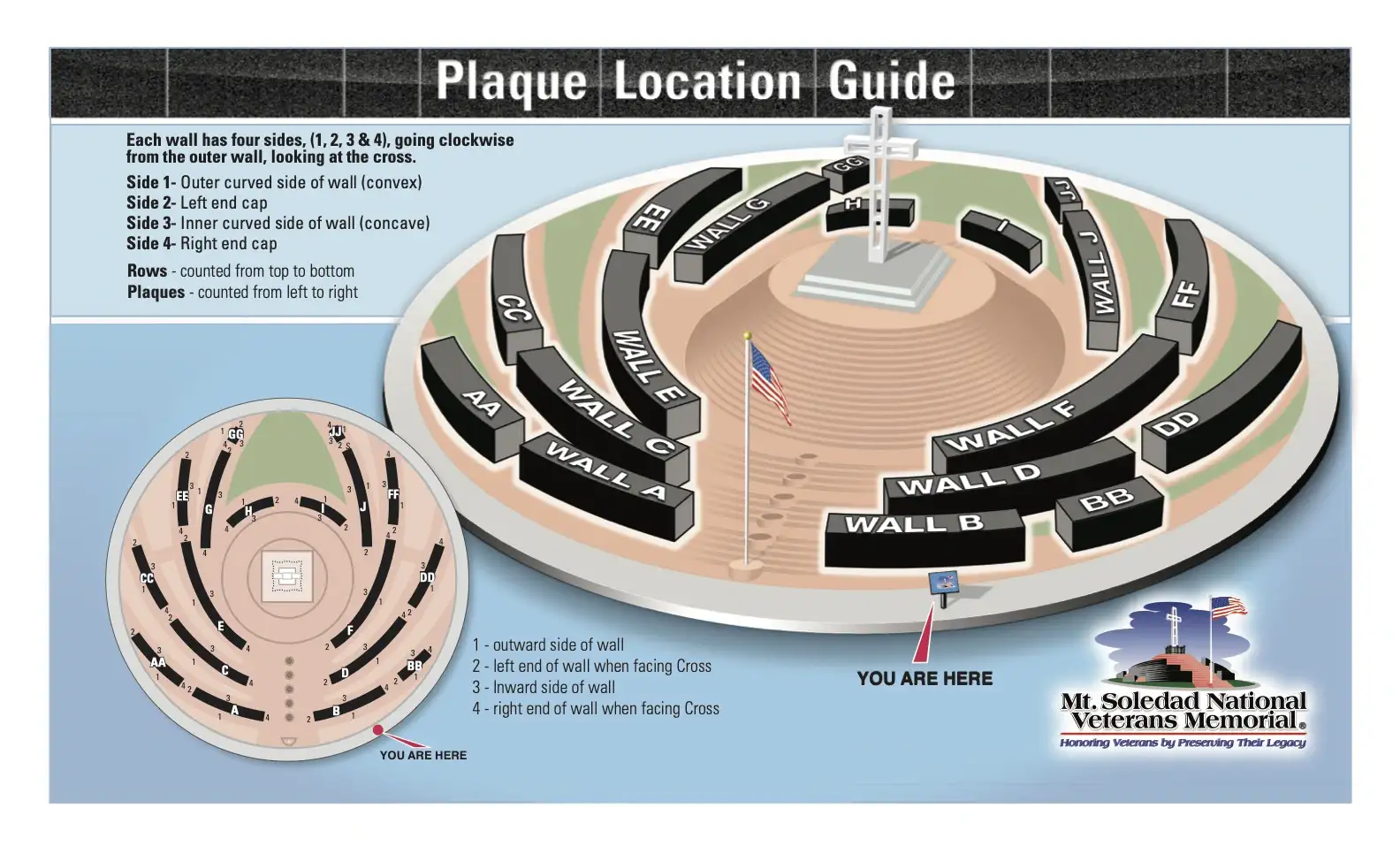
| Wall | I |
| Wall Side | 3 |
| Row | 4 |
| Plaque Number | 4 |
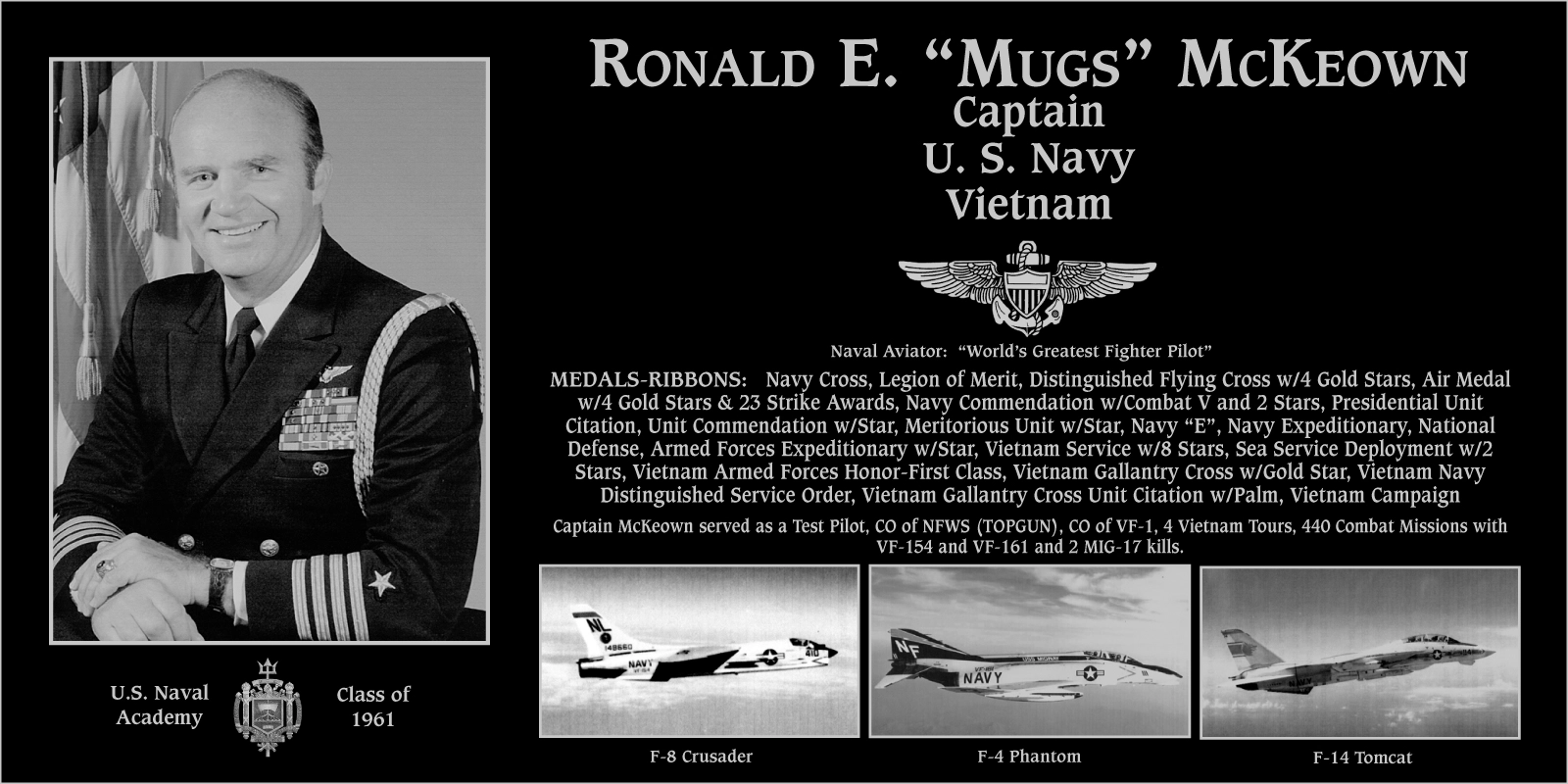
Naval Aviator: "World's Greatest Fighter Pilot"
MEDALS-RIBBONS: Navy Cross, Legion of Merit, Distinguished Flying Cross w/4 Gold Stars, Air Medal w/4 Gold Stars & 23 Strike Awards, Navy Commendation w/Combat V and 2 Stars, Presidential Unit Citation, Unit Commendation w/Star, Meritorious Unit w/Star, Navy "E", Navy Expeditionary, National Defense, Armed Forces Expeditionary w/Star, Vietnam Service w/8 Stars, Sea Service Deployment w/2 Stars, Vietnam Armed Forces Honor-First Class, Vietnam Gallantry Cross w/Gold Star, Vietnam Navy Distinguished Service Order, Vietnam Gallantry Cross Unit Citation w/Palm, Vietnam Campaign
Captain Mckcown served as a Test Pilot, CO of NFWS (TOPGUN), CO of VF-1, 4 Vietnam Tours, 440 combat missions with VF-154 and VT-161 and 2 MC-17 kills.
Tactics Manager he was charged with developing Navy tacti
cal doctrine for the F4 Phantom and had the opportunity to fly
the Soviet built MIG-17 and MIG 21 aircraft.
In 1969, he was assigned to Fighter Squadron 161 as
Operations Officer. In early 1972, with only 48 hours notice
he embarked aboard USS Midwav for his fourth combat
deployment to Southeast Asia. On May 23rd, while leading
a section of F4s on a Combat Air Patrol North of Hanoi near
the enemy airbase at Kep, McKeown and his RIO, LT Jack
Ensch, along with their wingmen were attacked by six North
Vietnamese MIG aircraft. In what has been described as one
of the longest and most exciting dogfights of the war, fight
ing often at tree-level height, McKeown and Ensch actually
tumbled their F4 end-over-end during the engagement. When
it was over McKeown had shot down two MIG-17s, includ
ing one off his wingmen’s tail and then chasing the remaining
enemy aircraft into China. For this action, McKeown and
Ensch were awarded the Navy Cross.
Ronald E. McKeown, Captain USN (Ret.)
“Mugs”
Captain McKeown is a Native of Ysleta, Texas where he
was an outstanding student and athlete. Upon graduation,
he was selected as an undergraduate at Harvard, Princeton,
and Dartmouth, He opted. instead, to attend the United
States Naval Academy at Annapolis, Maryland. While at
the Academy, he excelled in football and boxing. Playing
alongside Heisman Trophy winner, Joe Bellino, he was “The
other running back,” on the 1960 Navy team that played in
the Orange Bowl, beat Army, Air Force, Notre Dame, and the
then number one ranked team in the country, the University
of Washington. The 1960 Midshipmen were ranked #3 in the
nation. McKeown also was the recipient the “Spike Webb
Award,” emblematic of the outstanding boxer in the Naval
Academy; where he was the undefeated light-heavyweight
Champion of the Brigade of Midshipmen for three consecu
tive years.
Following graduation from the Academy, Ensign McKeown
attended Navy Flight Training and received his wings as a
Naval Aviator in November of 1962. He was then assigned to
Fighter Squadron 154 flying F8U Crusaders. He participated
in the first raids against North Vietnam in 1964. Prior to his
second cruise to Southeast Asia, the squadron transitioned to
the F4B Phantom. During that cruise McKeown was selected
to attend the U.S. Air Force Aerospace Research Pilot School
for test pilot and astronaut training. While there, he flew a
specially modified F104 to an attitude of 127,000 feet. He
then reported to Air Test and Evaluation Squadron FOUR. In
his role as Chief Test Pilot, he was in charge of all engineer
ing changes to the SPARROW air-to-air missile. As the F4
Following this action. Lieutenant Commander McKeown
received orders to become the first Commanding Officer of
TOPGUN, the Navy Fighter Weapons School. Thirteen days
after McKeown departed Midway, his friend and companion
was shot down and taken prisoner. During Jack’s incarceration
McKeown steadfastly refused to accept the Navy Cross, stat
ing that he and Jack had won them together and would wear
them the first time together. After his repatriation, McKeown
was also able to work the Navy personnel system and have
Jack assigned to TOPGUN as an instructor where they would,
once again, fly together. McKeown would serve as TOPGUN
Commanding Officer for three years. During that period he
set the foundation to make TOPGUN the premiere Air-to-Air
tactics training school in the world. The squadron lost all of
its aircraft to the Israelis in 1973 during the Yom Kippur war.
In spite of post Vietnam budgetary constraints, McKeown
was able to replace the original 8 A4Ms with 10 new A4Ms.
as well as 10 T38s and then procure 12 brand new F5Es.
After a brief tour in the Pentagon, McKeown assumed
command of Fighter Squadron ONE and as fate would
have it, Lieutenant Commander Ensch reported aboard as
the Maintenance Officer. The “Dynamic Duo” was back
and ready for Prime Time! From Fighter Squadron ONE,
McKeown went on to become the F14 Tomcat Project
Officer. He then went on to be Chief of Staff for Operations,
Commander Carrier Group Eight. During his tenure in
COMCARGRU staff working for RADM Jim Service and
RADM Jerry Tuttle, the battlegroup developed electronic
warfare tactics and procedures that bore fruit in the Gulf of
Sidra, Desert Shield, Desert Storm, and Iraqi Freedom. His
final tour was as Chief of Staff and Executive Assistant to the
Chief of Naval Material.
Captain McKeown’s personal awards include the Navy
Cross, Legion of Merit, Distinguished Flying Cross (5), Air
Medal (27), Navy Achievement Medal (14). He flew 440
combat missions in Southeast Asia and amassed 997 carrier
landings
Plaque Wall Map