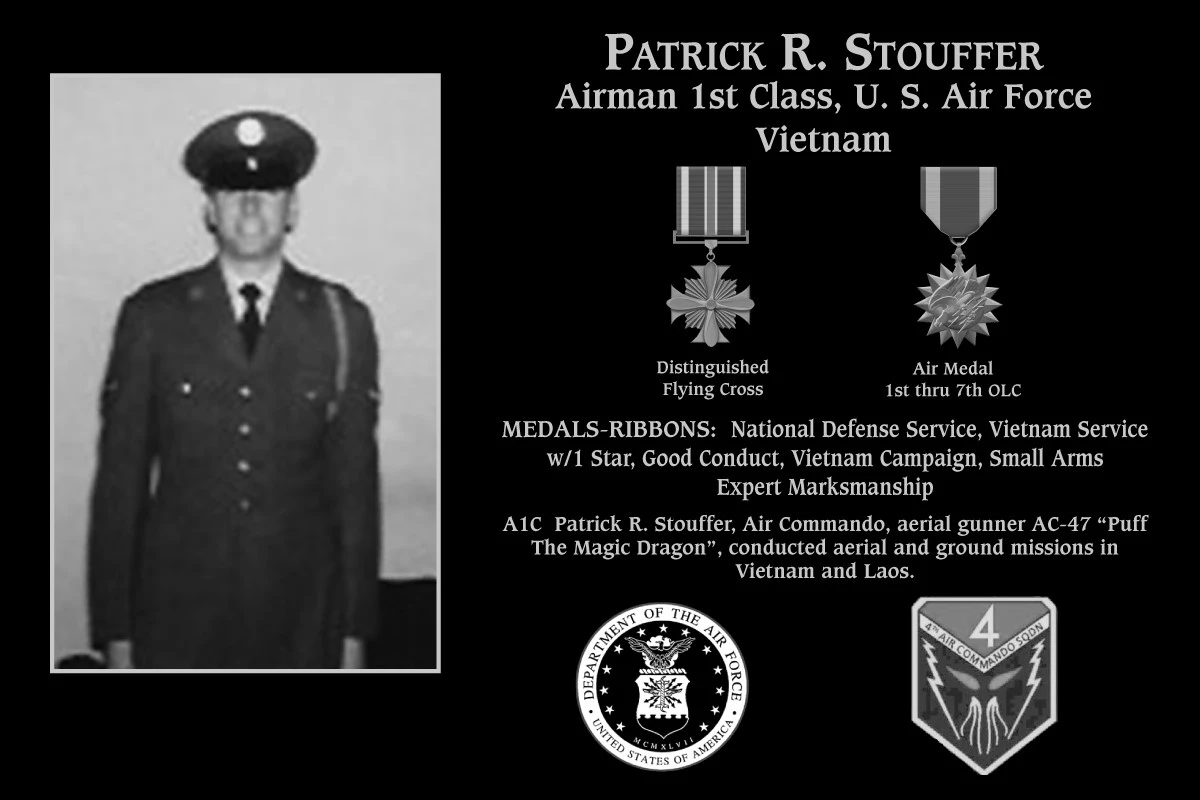
Patrick R. Stouffer
| Era | Vietnam War |
|---|---|
| Branch | U.S. Air Force |
| Rank | Airman First Class |
| Military Decorations | Distinguished Flying Cross |
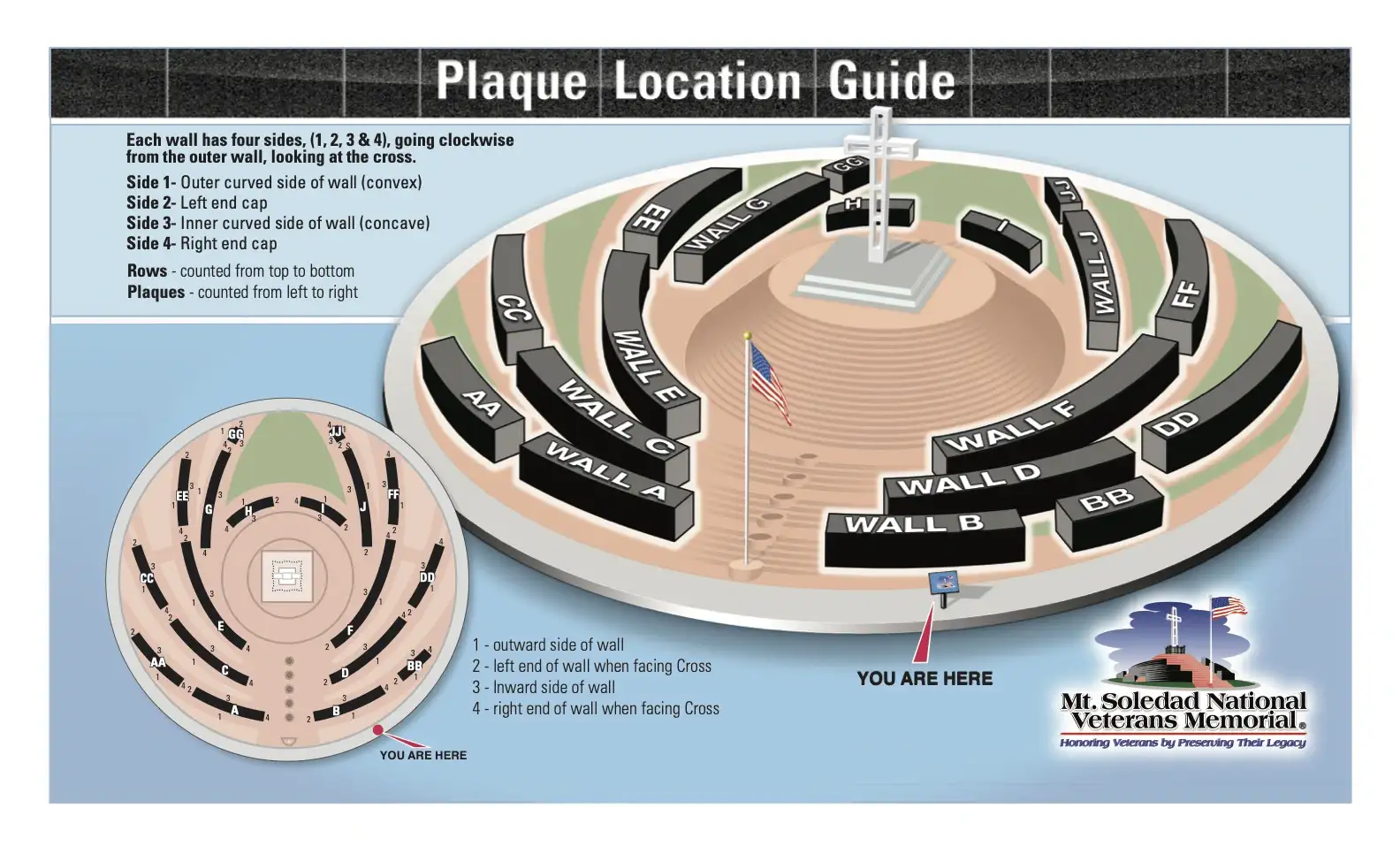
| Wall | G |
| Wall Side | 3 |
| Row | 4 |
| Plaque Number | 33 |
MEDALS-RIBBONS: National Defense Service, Vietnam Service W/1 Star, Good Conduct, Vietnam Campaign, Small Arms Expert Marksmanship
A1C Patrick R. Stouffer, Air Commando, aerial gunner AC-47 "Puff The Magic Dragon", conducted aerial and ground missions in Vietnam and Laos.
Airman First Class Patrick R. Stouffer
Served in the US Air Force from Sept. 19, 1963 - Sept. 15 1967
Upon enlisting in the US Air Force, Pat got his first ride in a commercial aircraft, on his way to Phoenix to take his physical.
Basic training at Lackland Air Force Base, San Antonio, Texas.
Pat’s first time in Texas and he got to visit the Alamo on a 4 hour pass.
Attended Technical School at Lowry Field outside of Denver, Colorado, where he saw his first MacDonald’s hamburger fast food restaurant.
Took his first flight in a helicopter.
Pat attended weapons specialist school, learning about everything from small arms to tactical nuclear weapons.
First assignment was with the 474 Tactical Air Command wing, Clovis New Mexico. From there he was deployed to both Misawa AB in Japan, and Kunsan AB in South Korea, where his assignment was manning a nuclear attack site. There were 8 F-100 Super Sabre jet fighters at our location, all targeting Russia. The “Cold War”.
Airman 2nd Class Stouffer was chosen along with 15 other airmen to reactivate the 4th Air Commando Squadron in early 1965. Reported to Hurlbert Field in Florida for commando training.
Note: The Billy Mitchell raiders trained for aircraft carrier takeoffs on the taxiway at Hurlbert field in 1942 in preparation for the first bombing raid on Japan during WWll. The taxiway is still called the Billy Mitchell taxiway, and Pat used it every day.
His training included Aerial gunnery training, parachute jump qualifying, including water landings, high altitude flight training, jet aircraft ejection training, Kendo and Aikido martial arts training, small arms training where he qualified as an “Expert Marksman”, numerous survival training schools including Prisoner of War training, concentration camp training, field medic training, jungle survival school where Phillipine pygmy Negrito Natives (indigenous to the island) were employed to hunt the commandos down in the jungle.
Deployed to Nha Trang in So. Vietnam and detached to Bien Hoa AB, outside Siagon, flying hundreds of night interdiction missions in AC-47 gunships, nick named “Puff the Magic Dragon” by the Viet Cong because of the flames and roar that was produced when the guns fired. Their radio call sign was “Spooky”, because they operated only at night with devastating effect.
Redeployed to Nakhon Phenom AB in the Northern Tailand/Loas area. Nakhon Phenom was a small, secret forward operating base populated by Air Commandos and some CIA operatives, and tasked with various missions such as;
Flying night bombing interdiction missions in the Mu Gia Pass area of North Vietnam,
Search and rescue missions looking for downed US fighter pilots in Laos and North Vietnam.
Pat also conducted ground incursions into Loas, either accompanied by a CIA operative and assisting him in contacting the Hmung fighters who were our allies in the area, or as 2 man Commando teams operating behind enemy lines, primarily engaging in intelligence gathering in the Hoi Chi Min Trail area.
Returned to Bien Hoa AB and resumed AC-47 duty.
John Steinbeck, renowned author and war correspondent flew as an observer on Pat’s plane one night. In his subsequent article describing his night in “Puff the Magic Dragon”, he called it “the scariest thing he had ever done”.
One night while defending an Army Green Beret outpost, Pat’s aircraft encountered heavy enemy ground fire and was shot down, crash landing at night. The entire crew survived with only some minor injuries. “We were flying again the next night.”
For his service, Pat was awarded 8 Air Medals and the Distinguished Flying Cross.
“I flew my last mission in mid September 1967, flew home the next day and was honorably discharged at Travis AFB outside San Francisco. I was picked up by a high school friend and driven directly to the intersection of Haight and Ashbury streeets in downtown San Francisco on September 15, 1967, the ‘Summer of Love’.”
“I had flown my last combat mission 3 days prior, Welcome Home!”
Plaque Wall Map